Overrated: 5 AI Tools Everyone Recommends That Aren't Worth Your Money
Five hyped AI tools that may not justify their price tags for solo creators. We break down what you actually get vs. what you pay.

You signed up because three different newsletter writers, two YouTube creators, and a Reddit thread all swore it would change your workflow. Six weeks later you’re looking at another charge on your card and wondering what, exactly, changed. If that loop sounds familiar, this guide is for you.
The AI tools industry moves fast, and hype moves faster. A tool can dominate every “best of” list for months before anyone publicly admits the free tier was the only part worth using, or that the paid features are built for 20-person marketing teams — not a solo creator juggling client work at midnight. Below, we break down five tools that consistently top recommendation lists but, in our assessment, struggle to justify their price tags for the $20–60/month solo-creator budget.
A quick caveat before we start: pricing changes frequently. Every figure mentioned below was accurate at time of research, but you should always verify on each tool’s official pricing page before making a decision.
1. Jasper AI — Built for Teams, Priced for Teams
Jasper is probably the most recommended AI writing tool on the internet. It has polished branding, a long feature list, and a genuinely active user community. The problem is that almost everything that makes Jasper Jasper — brand voice management, team collaboration, campaign workflows, multi-seat permissions — only matters if you are not working alone.
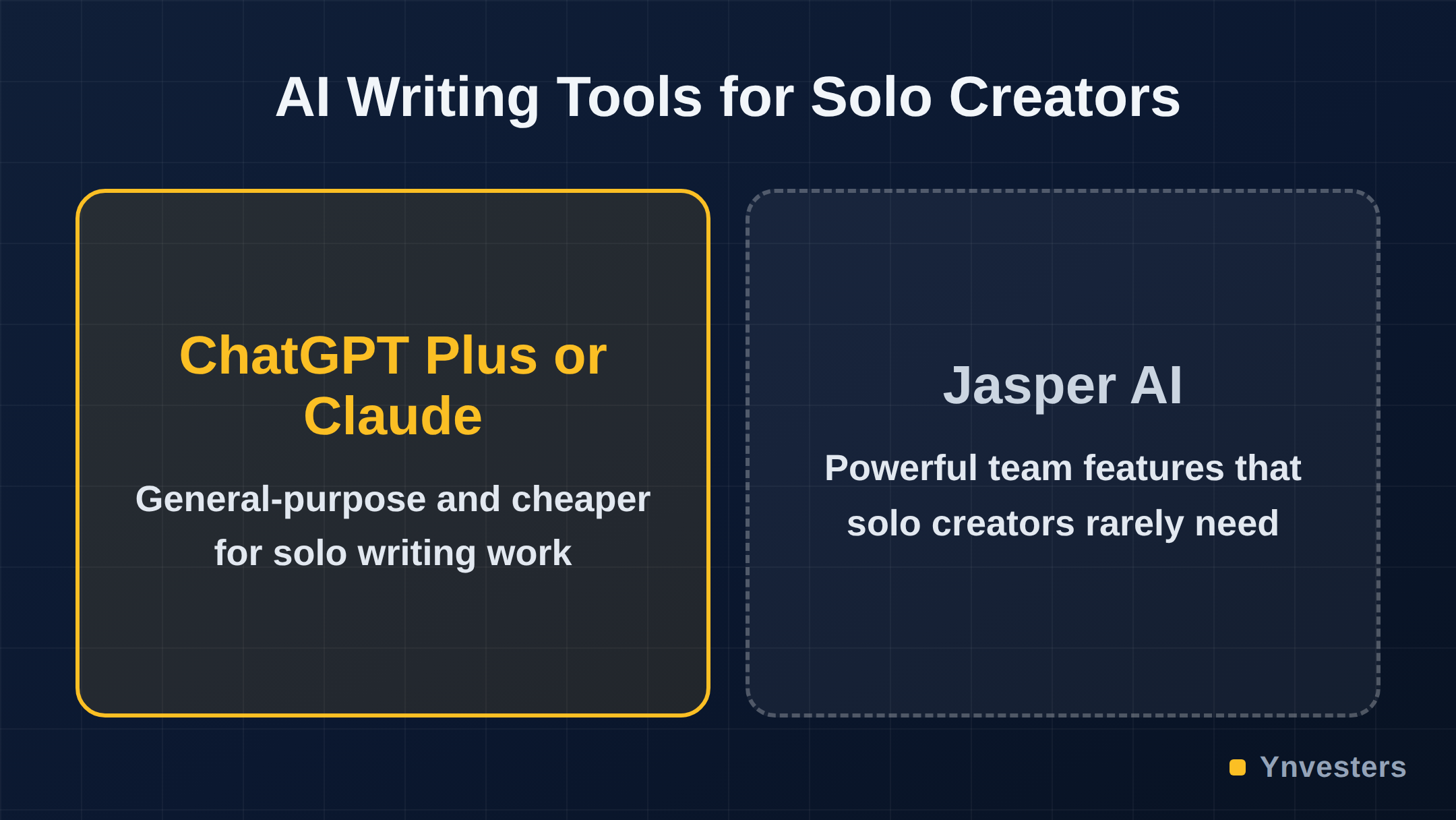
For a solo creator, Jasper’s core output is AI-generated prose. That is also what ChatGPT Plus and Claude produce, at lower monthly costs and with models that are updated at least as frequently. Jasper’s templates can be useful when you are first learning to prompt, but they become training wheels you outgrow quickly.
Our take: if you are a solo creator, the practical benefit you get from Jasper’s paid plan does not meaningfully exceed what a general-purpose AI assistant already in your stack can deliver. Verify Jasper’s current pricing at jasper.ai/pricing and compare it honestly against what you are already paying.
2. Grammarly Premium — Polishing a Floor That Is Already Clean
Grammarly’s free tier is genuinely excellent. It catches spelling errors, flags obvious grammar mistakes, and does it quietly inside your browser. That part earns its place.
Grammarly Premium, though, charges a meaningful monthly fee to add style suggestions, tone adjustments, and clarity rewrites on top of the free core. The issue is that those Premium-layer suggestions have become increasingly available elsewhere. Google Docs has a built-in “Help me write” feature. Microsoft Word’s editor flags many of the same style issues. If you are already using a large language model to draft or review your writing, you are already getting a layer of style feedback that overlaps significantly with what Grammarly Premium offers.
This is not a knock on Grammarly’s engineering — their suggestions are often good. It is a budget question: are those suggestions worth a recurring subscription fee when your existing tools already cover the gap? For most solo creators we think the answer has shifted to no, unless your work involves large volumes of client-facing copy that must pass a style review every single day.
Check the current Grammarly Premium price at grammarly.com/upgrade and weigh it against what you already have.
3. Otter.ai Paid — When the Free Tier Was the Good Part
Otter.ai does a genuinely useful thing: it transcribes spoken audio into readable text in near-real time. The free plan gives you a meaningful number of transcription minutes per month and handles most casual use cases — recording a client call here, capturing a brainstorm there.
The paid tier unlocks higher minute limits, longer individual recording lengths, and some collaboration features. For a solo creator who records infrequently, the free plan already covers the workflow. For a creator who records heavily — say, a podcaster or someone running back-to-back client calls daily — the paid tier’s limits can still feel restrictive compared to what you might expect for the price.
Beyond Otter, the transcription space has become crowded. OpenAI’s Whisper model is open-source and powers several free or low-cost transcription tools. Competitors like Riverside.fm and Descript offer transcription as part of broader audio/video production packages, which can deliver more value per dollar if you are editing recordings, not just reading them.
Verify current Otter.ai pricing at otter.ai/pricing before upgrading.
4. Copy.ai — Solving a Problem You May Have Already Solved
Copy.ai built its audience in an era when getting coherent AI-generated marketing copy required a specialized tool with purpose-built templates. That era has mostly passed. General-purpose models now produce ad copy, product descriptions, and email sequences with a well-written prompt and no specialized interface required.
Copy.ai has continued adding features — workflows, automation, and integrations — aimed squarely at marketing operations teams. That evolution makes sense for their business. It also means the paid tiers are increasingly designed for teams running content pipelines at scale, not for a freelance copywriter who needs to draft five product descriptions for a client on Thursday.
The free plan remains a reasonable way to explore. The paid plans, at their current price points (verify at copy.ai/pricing), are harder to justify unless you are actively using the workflow and automation features — which require a team to be worth the overhead.
5. Notion AI — An Add-On You May Already Be Paying For Elsewhere
Notion is beloved as a workspace tool, and rightfully so. Notion AI, the add-on layer that embeds AI assistance inside your Notion workspace, is where the value calculation gets tricky.
Notion AI charges an additional monthly fee per member on top of your existing Notion plan. For a solo creator already paying for Notion, that additional charge adds AI-assisted drafting, summarization, and Q&A over your documents. Those features are genuinely convenient if Notion is your primary writing and thinking environment.
The catch: if you already have ChatGPT Plus or Claude open in a browser tab while you work in Notion — which many users do — you are paying for meaningfully overlapping functionality. Copy-pasting a Notion page into Claude for a summary is not as seamless as clicking “Summarize” inside Notion, but it is not a workflow that costs an extra monthly subscription either.
Our take is that Notion AI is a reasonable convenience purchase, not an essential one. If you are already paying for a general-purpose AI assistant, you are already 80% of the way there. Check current Notion AI add-on pricing at notion.so/pricing.
Comparison Table: What You Get vs. What You Pay
| Tool | Who It’s Actually Built For | Solo Creator Value | Cheaper Alternative |
|---|---|---|---|
| Jasper AI | Marketing teams, agencies | Low — team features dominate | ChatGPT Plus, Claude |
| Grammarly Premium | High-volume copy editors | Medium — useful, but overlapping | Google Docs editor, Claude |
| Otter.ai Paid | Heavy recorder, teams | Low-medium — free tier covers most solo use | Whisper-based tools |
| Copy.ai Paid | Marketing ops teams | Low — general LLMs now match output | ChatGPT Plus with good prompts |
| Notion AI Add-On | Notion-primary users | Medium — convenient but duplicative | Claude in a second tab |
Conclusion
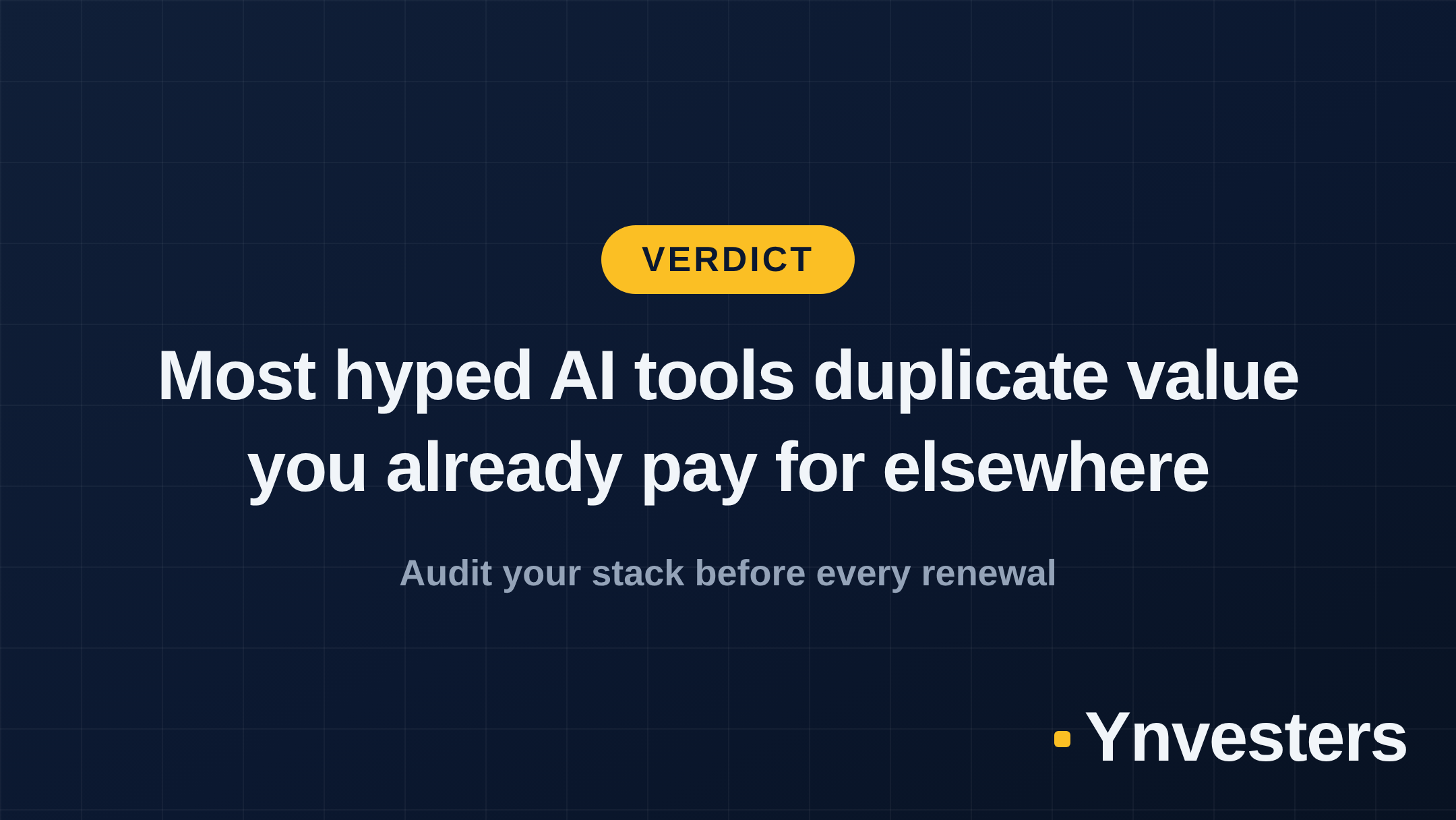
The pattern across all five tools is the same: they were built to solve real problems, they solved them early, and then the baseline capabilities of general-purpose AI models caught up. What once required a specialized subscription now requires a well-written prompt in a tool you are likely already paying for.
Our recommendation for solo creators operating on a $20–60/month AI budget: anchor your stack on one strong general-purpose model — ChatGPT Plus or Claude are the current benchmarks — and only add a specialist tool when it solves a specific workflow gap that your general model provably cannot close. Do not add a tool because a newsletter recommended it. Add it because you have identified the exact job it does that nothing else in your stack does.
If any of the five tools above is already in your subscriptions list, open the billing page right now and ask yourself: what did I actually use this for in the last 30 days that I could not have done in ChatGPT? If the answer is nothing, that is your answer.
Frequently Asked Questions
Is Jasper AI worth the money for a freelancer?
For most solo freelancers, our take is no. Jasper is built around team workflows and brand voice management features that one-person operations rarely need. ChatGPT Plus or Claude offer comparable prose generation at a lower monthly cost.
Is Grammarly Premium worth it in 2026?
Grammarly Premium is useful for catching style and clarity issues, but many of its core suggestions now appear in free tools like Google Docs or built-in browser spell-checkers. Verify current pricing on Grammarly's site, then weigh it against free alternatives before subscribing.
How much does Otter.ai cost?
Otter.ai offers a free plan with limited monthly transcription minutes and paid tiers above that. Pricing changes regularly, so check otter.ai/pricing for the current figures before committing.
What should I use instead of these overrated AI tools?
ChatGPT Plus, Claude, and Whisper-based transcription tools cover most use cases that these five tools target, often at lower combined cost. Match the tool to a specific workflow gap rather than subscribing based on hype.