OpenAI's ChatGPT for Small Business Program 2026: What It Is and Is It Worth It?
OpenAI just launched a ChatGPT for Small Businesses program. Here's what's announced, what's still unknown, and whether it matters for your workflow.
You’re running a five-person operation, wearing four hats at once, and somewhere between responding to a client email and updating a spreadsheet, you think: there has to be a better way to use this AI thing everyone keeps talking about. You’ve poked at ChatGPT, maybe even paid for a subscription, but it’s never quite felt like something designed for you — more like a powerful tool with no instruction manual for actual small business life.
That might be about to change. OpenAI has officially announced the ChatGPT for Small Businesses program, a dedicated initiative aimed at helping entrepreneurs build AI skills, automate their work, and grow using ChatGPT Work. It’s a notable shift in how OpenAI is positioning its flagship product — less “general AI assistant,” more “co-pilot for the bootstrap crew.” Here’s what we know, what we don’t, and whether you should care right now.
What Is the ChatGPT for Small Businesses Program?
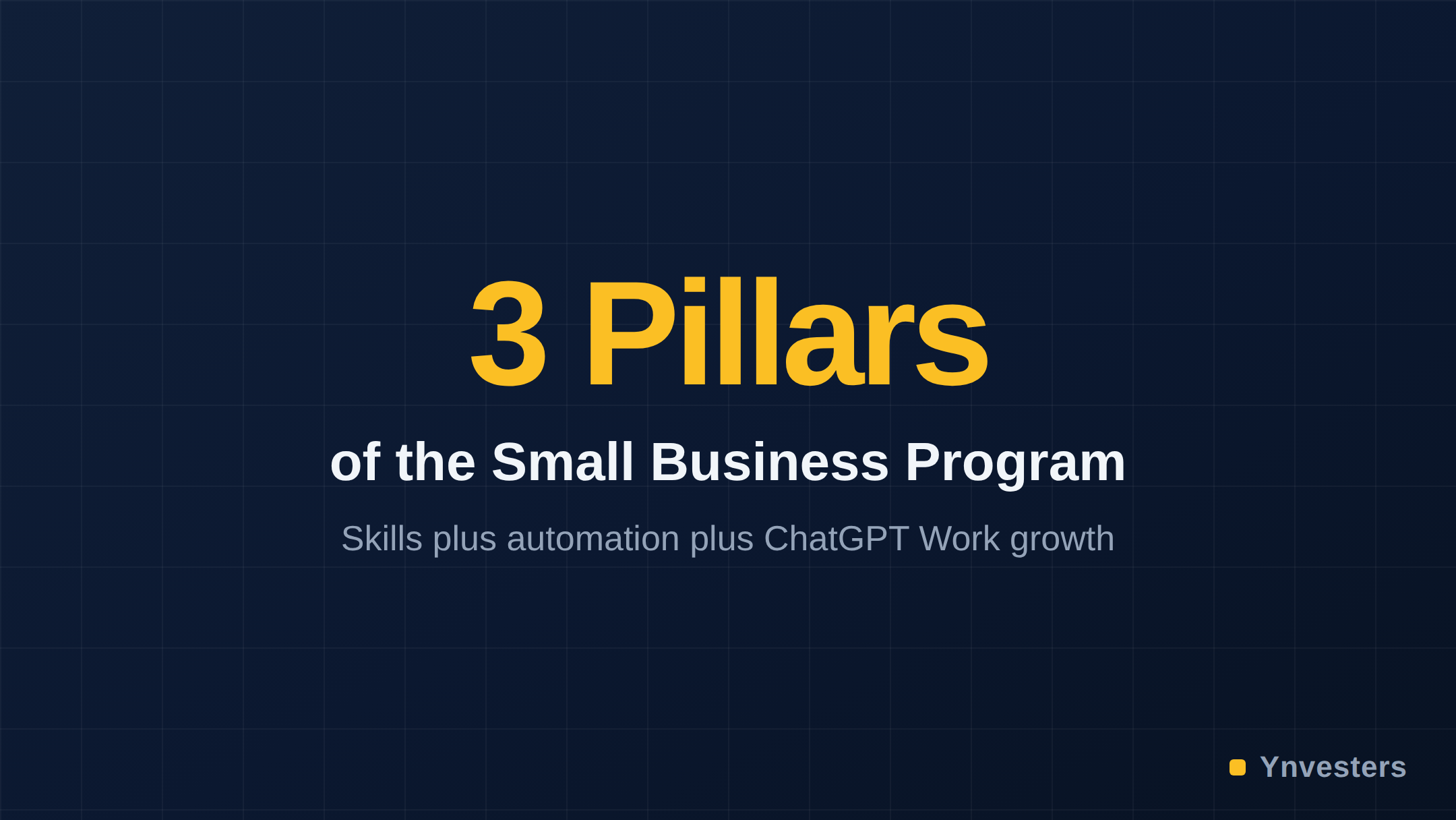
According to OpenAI’s announcement, the program has three stated pillars:
- Building AI skills — helping small business owners and their teams actually learn to use ChatGPT effectively, not just dabble with it
- Automating work — applying ChatGPT to repetitive tasks that eat into founder time
- Growing with ChatGPT Work — the program is anchored to ChatGPT Work, OpenAI’s business-oriented product tier
That last point matters. ChatGPT Work is OpenAI’s umbrella for its business-facing products, which includes the ChatGPT Team plan and enterprise offerings. The new small business program appears to be a structured on-ramp to that ecosystem — but OpenAI hasn’t spelled out exactly how.
What the announcement doesn’t include — and this is worth flagging clearly — is specific pricing, a feature-by-feature breakdown, or a confirmed availability date for all markets. We’re working from a high-level program description. If you’re evaluating whether to budget for this, check the official page directly before making any decisions, as details are likely to follow in subsequent announcements.
Why OpenAI Is Doing This Now
OpenAI isn’t launching this program in a vacuum. The competitive pressure in AI productivity tools is intense: Google’s Gemini for Workspace, Microsoft’s Copilot for Microsoft 365, and a growing list of specialized tools are all aggressively courting the small-to-medium business segment.
For OpenAI, the small business market represents a massive addressable audience that falls between two stools: consumer ChatGPT (powerful but unstructured) and enterprise contracts (too expensive and complex for a ten-person shop). A dedicated program with training resources and a workflow-focused product tier is a logical move to own that middle ground.
There’s also a retention argument. Getting small businesses to build workflows and habits around ChatGPT Work makes them far stickier customers than individual subscribers who might cancel the moment a cheaper alternative appears.
What “Building AI Skills” Actually Means in Practice
The skill-building component is potentially the most underrated part of this announcement. The biggest barrier to AI adoption for small businesses isn’t access — it’s knowing what to do with access.
Real-world ChatGPT users back this up consistently. On r/ChatGPT, one highly upvoted user described using it for “rewording emails and messages before I send them, cross checking information, making sure I have schedules right” — exactly the kind of unglamorous, daily friction that eats a founder’s afternoon. Another noted using it like “an intern who doesn’t complain or get tired” for coding tasks. These are not power-user workflows. They’re basic, high-value applications that most small business owners haven’t systematically implemented.
If OpenAI’s skill-building component delivers structured guidance — templates, use-case libraries, onboarding flows — it could meaningfully close that implementation gap. Generic access to a model is one thing; knowing how to prompt it for a client proposal or a hiring post is another.
What Real Users Say
Before anyone buys into a program framing, it’s worth grounding expectations in how people actually use ChatGPT today. The r/ChatGPT community is candid about both the wins and the limitations.
One user with nearly a thousand upvotes summed up the practical value bluntly: using ChatGPT for “rewording emails, cross-checking information, and making sure schedules are right” — it’s useful, they say, especially “for people like me that overthink simple things to death.” Another commenter described the appeal of coding assistance as having “an intern who doesn’t complain or get tired,” which captures why the automation angle of this program is resonant for solo operators.
The community isn’t entirely starry-eyed, though. One r/ChatGPT user self-deprecatingly noted they use it to “simplify stuff to a level where my smooth unwrinkled brain can understand” — a reminder that the tool’s value often comes from lowering the cognitive load of tasks, not replacing expertise. And in a wry moment of humor, another user compared a model’s counting behavior to being “better than most data scientists” — a signal that users are very aware of where AI falls short, even when they keep coming back to it.
The takeaway: real small business users already rely on ChatGPT for email, scheduling, and coding assistance. A program that formalizes and structures that use — rather than expecting people to figure it out alone — is addressing a genuine friction point.
The Feature Gap: What We Still Don’t Know
To be direct with you: as of this article’s publication, the announcement is lean on specifics. Here’s what remains unconfirmed:
| Detail | Status |
|---|---|
| Program pricing | Not announced |
| Countries/regions available | Not specified |
| Specific training curriculum | Not detailed |
| How it differs from ChatGPT Team plan | Not clarified |
| Whether there’s a free tier or trial | Not mentioned |
This isn’t a knock on the program itself — it’s common for OpenAI to announce a program directionally before filling in all the details. But it does mean you shouldn’t restructure your toolstack around this yet. Bookmark the official page and revisit it when the full feature set drops.
How It Stacks Up Against Existing Options
If you’re already spending on AI tools, you’re probably wondering whether this program is additive or redundant. Here’s our current read, based on what’s publicly available:
If you’re on ChatGPT Plus ($20/month): The Plus plan gives you access to the latest models but is fundamentally a single-user consumer product with no team features or business-specific workflow structure. The small business program, built around ChatGPT Work, likely sits above this tier in both features and price.
If you’re on ChatGPT Team: This already gives you a shared workspace, admin controls, and higher usage limits. Whether the small business program adds something meaningfully different — or is essentially a repackaging with training resources bolted on — is something OpenAI needs to clarify. Verify on their site before assuming you’d need to upgrade.
If you’re using Google Gemini for Workspace or Microsoft Copilot: Those tools have the advantage of deep integration with their respective productivity suites (Docs/Sheets and Office 365). ChatGPT Work’s edge is typically raw model capability and flexibility. If your team lives in Google Workspace, the switching cost is real.
Who Should Pay Attention Right Now
Pay attention if you are:
- A bootstrapped founder or small team (roughly under 50 people) with no dedicated ops or IT function
- Already using ChatGPT informally but getting inconsistent results
- Looking for a structured program rather than figuring out AI workflows alone
- Curious about how to automate email, scheduling, client communications, or basic coding tasks
It’s probably not for you if you are:
- Already running a well-integrated Microsoft 365 or Google Workspace setup — switching costs are high
- A solo creator who only uses AI occasionally; the free tier of ChatGPT likely covers your needs
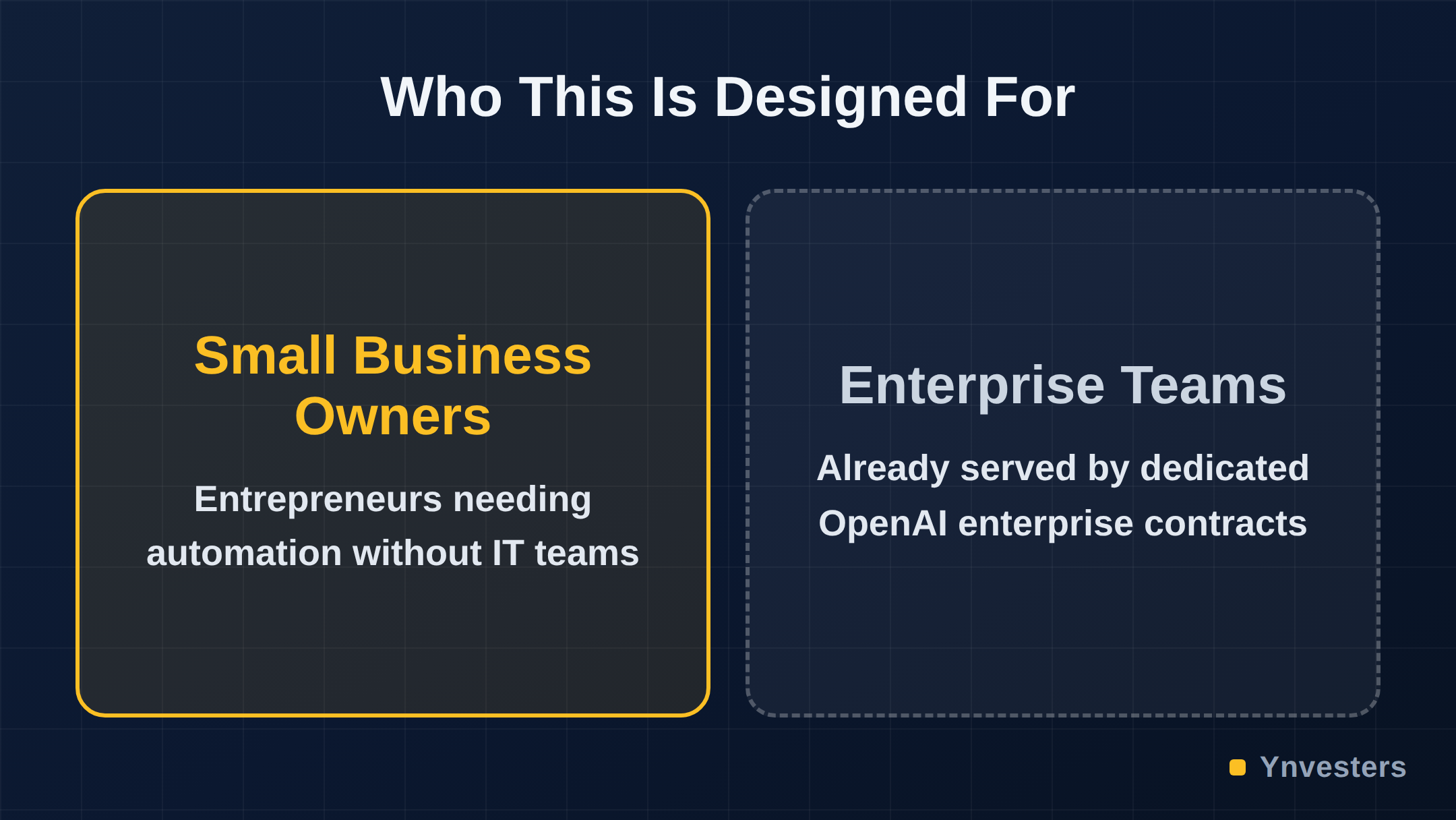
- An enterprise with an IT team — OpenAI’s enterprise products are the right conversation for you
Conclusion
OpenAI’s ChatGPT for Small Businesses program is a smart strategic move, and the three-pillar framing — skills, automation, growth — maps directly to the real problems small business owners face when trying to get consistent value out of AI tools. The emphasis on ChatGPT Work as the underlying product suggests this isn’t just a marketing wrapper; it’s meant to be a structured, business-grade experience.
That said, we can’t tell you whether to pay for it yet, because OpenAI hasn’t told us what it costs or exactly what you get. Recommending a product without pricing is like telling you to order from a menu with no prices — the food might be great, but you still need to ask before you sit down.

Our verdict: If you’re a small business owner who’s been waiting for OpenAI to take your segment seriously, this program is worth tracking closely. The concept is right. But until OpenAI publishes a clear feature list and price point, the smartest action is to read the official announcement, sign up for any waitlist or notification offered, and continue with whatever AI workflow you have today. Don’t cancel, don’t upgrade, don’t restructure — just watch. The specifics will make or break it, and they’re coming.
Frequently Asked Questions
How much does the ChatGPT for Small Businesses program cost?
OpenAI has not announced specific pricing for the program as of this writing. Check the official announcement page at openai.com for current figures before signing up.
Is the ChatGPT for Small Businesses program worth it?
It depends on whether you're already paying for ChatGPT Team or Plus. If you are, wait to see what additional value the program adds. If you're not yet using ChatGPT for work, this program could be a structured entry point.
What is ChatGPT Work and how does it relate to this program?
According to OpenAI's announcement, the program is built around ChatGPT Work — OpenAI's business-focused tier. It bundles skill-building and automation features aimed specifically at small business owners.
Who is the ChatGPT for Small Businesses program designed for?
The program targets entrepreneurs and small business owners who want to automate tasks and build practical AI skills, not large enterprises with dedicated IT teams.