Perplexity AI Pro vs ChatGPT Plus: Which Search AI Is Worth $20/Month?
Perplexity AI Pro vs ChatGPT Plus compared on pricing, features, and real-world value. Find out which $20/month AI subscription is worth it in 2026.
You open a tab, type a question, and ten minutes later you’re three browser windows deep, stitching together half-answers from sources you’re not sure you trust. Or you fire up your AI assistant and get a beautifully written paragraph that turns out to be confidently wrong. Neither option feels like the $20-a-month upgrade you were promised. That’s the exact tension driving the Perplexity AI Pro vs ChatGPT Plus debate right now — and if you’re about to commit to one (or already paying for both and wondering why), this breakdown is for you.
What You’re Actually Comparing
Before diving into pricing tiers and feature checklists, it’s worth being honest about what these two tools are trying to do. They overlap significantly on the surface — both use large language models, both live in a browser tab, both claim to save you research time — but their core design philosophies diverge in ways that matter for your daily workflow.
ChatGPT Plus is OpenAI’s subscription tier layered on top of ChatGPT. It’s primarily a conversation and generation tool that has added browsing and search capabilities over time. You’re paying for access to GPT-4o, o1, o3-mini, image generation via DALL·E 3, Advanced Data Analysis, and a growing library of plugins and GPTs.
Perplexity AI Pro is built search-first. It’s an answer engine that cites its sources inline, lets you choose which underlying model powers each query, and is explicitly designed to replace your search bar rather than your text editor.
If you primarily need a writing partner, coding assistant, or creative collaborator, that framing alone already tells you something. If you need fast, cited, trustworthy research, that tells you something else.
The Pricing, Side by Side
Both tools land at the same monthly sticker price, which makes the comparison unusually clean.
| Feature | Perplexity AI Pro | ChatGPT Plus |
|---|---|---|
| Monthly price | $20/month | $20/month |
| Annual price | $200/year (~$16.67/mo) | $240/year ($20/mo) |
| Free tier available | Yes (5 Pro searches/day) | Yes (GPT-4o mini, limited) |
| Primary model | Choice: GPT-4o, Claude 3.5 Sonnet, Gemini 2.0 Flash, Sonar Pro | GPT-4o (default), o1, o3-mini |
| Web search / citations | Always on, inline citations | Optional (Search tool) |
| Image generation | Yes (DALL·E 3, Stable Diffusion, FLUX) | Yes (DALL·E 3) |
| File uploads | Yes (PDFs, images) | Yes (PDFs, images, data files) |
| Code interpreter | No dedicated tool | Yes (Advanced Data Analysis) |
| Custom instructions | Limited | Yes (persistent memory) |
| API access included | No | No (separate API pricing) |
| Mobile app | iOS + Android | iOS + Android |
One important nuance on annual pricing: Perplexity’s annual plan at $200/year saves you $40 compared to paying monthly. OpenAI currently does not offer a discounted annual rate for ChatGPT Plus — it remains $20/month regardless of billing cycle. That’s a meaningful difference if you’re committed for a year.
What You Get With Perplexity AI Pro
Perplexity’s free tier is genuinely useful — you get unlimited standard searches and five “Pro” searches per day. Pro searches use more powerful models and deeper web crawling. The paid tier removes that cap and unlocks the following:
Model switching. This is Perplexity’s biggest differentiator. On a single Pro account, you can route queries to Claude 3.5 Sonnet for nuanced reasoning, GPT-4o for general tasks, or Google’s Gemini models for certain research tasks. You’re not locked into one AI vendor — you’re buying a research interface that sits on top of several.
Perplexity Pro Search. The default “Pro” mode uses a more thorough crawl, reads more sources per query, and synthesizes longer, more structured answers. For market research, competitive analysis, or technical deep-dives, the quality difference versus standard search is noticeable.
Image generation. Pro users get access to DALL·E 3, Stable Diffusion XL, and FLUX image models. It’s not the primary use case, but it’s included.
Perplexity Pages. A newer feature that lets you turn a research query into a shareable, formatted document — useful for quickly producing briefing docs or summaries for teammates.
$5/month in API credits. Pro subscribers receive $5 monthly in Perplexity API credits, which is handy if you want to integrate its search into your own tools or automations.
What Perplexity doesn’t do well: It is not a writing assistant in any serious sense. It won’t help you draft a proposal, debug a React component, or iterate on a marketing email. The conversation memory is shallow. There are no persistent custom instructions the way ChatGPT Plus has them. If your work involves generation more than retrieval, you’ll feel the ceiling quickly.
What You Get With ChatGPT Plus
ChatGPT Plus has quietly become one of the most feature-dense AI subscriptions available, though its breadth can also make it feel unfocused.
GPT-4o access. The default model is fast, multimodal (it handles text, images, audio, and documents), and significantly more capable than the free GPT-4o mini. Response quality for writing, reasoning, and coding tasks is meaningfully better than the free tier.
o1 and o3-mini access. For complex reasoning tasks — mathematical proofs, multi-step logic, hard coding problems — OpenAI’s o-series models use chain-of-thought reasoning that often outperforms standard GPT-4o. These are included in Plus (with usage limits).
Advanced Data Analysis. Upload a CSV or Excel file and ChatGPT will write and execute Python code to analyze it, generate charts, and summarize findings. This feature alone is worth the subscription for anyone who works with data regularly and doesn’t want to open Jupyter Notebook for a quick pivot.
DALL·E 3 image generation. Integrated directly into the chat interface. Quality is strong for photorealistic prompts and consistent for illustrations.
Memory and custom instructions. ChatGPT Plus can remember facts about you and your preferences across conversations. You can also set persistent system-level instructions — tell it your writing style, your role, your preferred output format — and it applies them automatically.
GPT store and custom GPTs. Plus users can access and create custom GPT configurations tailored to specific workflows. There are thousands of community-built GPTs for everything from legal document review to recipe generation.
Web browsing. ChatGPT does browse the web, but it’s a secondary capability rather than the core product. Citations exist but are less structured than Perplexity’s inline sourcing. For quick factual lookups it works; for deep research synthesis, it lags behind Perplexity’s dedicated search architecture.
Real-World Scenarios: Which Tool Wins Where
Scenario 1: You need to research a competitor before a client call. Perplexity wins. It pulls recent news, financial data, product updates, and synthesizes them with citations in under 30 seconds. You can verify every claim before you walk into the meeting.
Scenario 2: You need to write a 1,500-word technical blog post. ChatGPT Plus wins. Its ability to follow custom instructions, maintain a consistent voice across a long piece, and iterate based on your feedback is in a different league.
Scenario 3: You uploaded a messy sales dataset and need a summary. ChatGPT Plus wins, and it’s not close. Advanced Data Analysis handles this natively; Perplexity doesn’t have an equivalent.
Scenario 4: You want to compare three SaaS pricing pages and extract key differences. Perplexity wins. It can crawl all three pages, pull the relevant data, and present a structured comparison — with links — faster than you could do it manually.
Scenario 5: You’re debugging a Python script at 11pm. ChatGPT Plus wins. The combination of code understanding, execution capability, and iterative conversation makes it the better coding companion by a significant margin.
The Case for Paying for Both (and When It Makes Sense)
Some professionals do run both subscriptions — $40/month total — and treat them as distinct tools rather than redundant ones. The logic holds if your work genuinely splits between deep research and heavy generation. A journalist who researches with Perplexity and drafts with ChatGPT, or a consultant who investigates market data in one tab and writes client deliverables in the other, will extract full value from both.
For most people, though, that’s paying for overlap. The honest question is: in a given workday, are you spending more time finding information or creating with it?
The Hard Numbers: April 2026 Test Results
These two tools are easy to debate in the abstract — harder to argue with when there’s actual test data.
An April 2026 evaluation found Perplexity Pro at 92% factual accuracy on real-time information queries versus ChatGPT’s 87% when browsing was enabled. The gap widened on specialized queries: for stock-related questions, Perplexity hit 94% accuracy versus ChatGPT’s 81% — primarily because Perplexity’s web index updates in near real-time while ChatGPT’s browsing relies on Bing’s index with a processing delay, per Tech Insider’s April 2026 head-to-head.
On citation reliability, a 100-query test by Zapier’s editorial team found Perplexity’s inline citations were verifiable and accurate 89% of the time. ChatGPT’s citations, when present, were accurate 76% of the time — but the bigger issue is that ChatGPT frequently omits citations entirely even when browsing is active, leaving users to take factual claims on faith, per Zapier’s 2026 analysis.
The data confirms what the design philosophy already suggests: if source traceability matters to your workflow, Perplexity’s architecture is built for it in a way ChatGPT’s is not.
Conclusion
If your primary frustration is unreliable search results and information you can’t trace back to a source, Perplexity AI Pro at $20/month (or $200/year) is the better buy. It’s purpose-built for research, its citations are its core feature rather than an afterthought, and the ability to switch between Claude, GPT-4o, and Gemini on a single subscription is genuinely useful.
If your work leans toward writing, coding, data analysis, or any task where you need a capable AI collaborator rather than a smarter search bar, ChatGPT Plus is the stronger value. The breadth of tools — Advanced Data Analysis, o1/o3 reasoning models, persistent memory, custom GPTs — gives it more surface area for professional workflows.
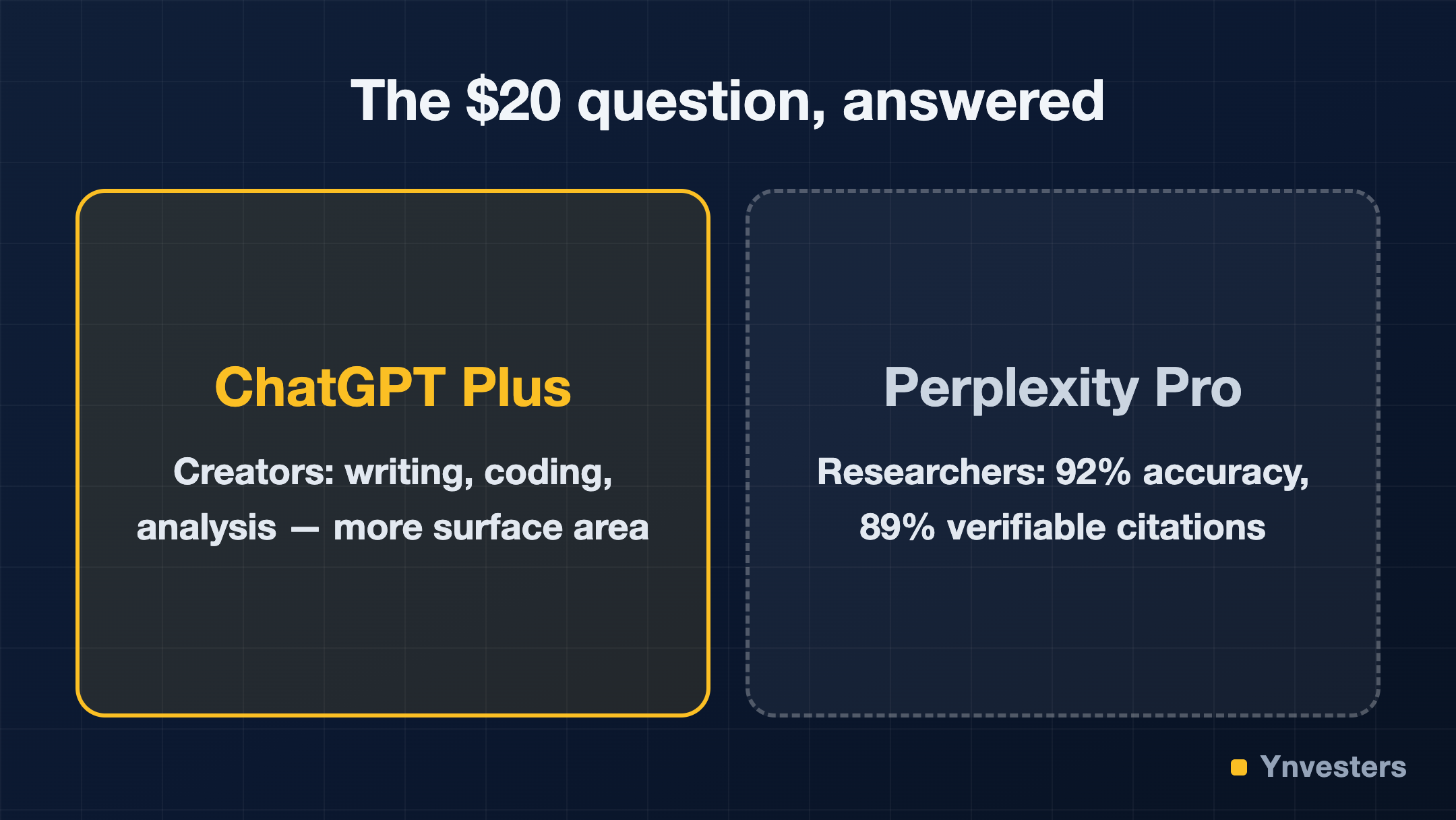
Our take, if you’re a solo creator who can only justify one $20 subscription: ChatGPT Plus is the default. Most creators spend far more hours producing — writing, coding, analyzing — than formally researching, and that’s exactly the surface ChatGPT Plus covers. Choose Perplexity Pro instead only if research with verifiable sources is your deliverable — analysts, journalists, academics. And if that’s you, pay annually: the $200/year plan saves $40 versus paying monthly.
Frequently Asked Questions
Perplexity Pro or ChatGPT Plus — which should I buy?
ChatGPT Plus for most solo creators (writing, coding, analysis). Perplexity Pro if verifiable research is your deliverable.
Is Perplexity more accurate than ChatGPT?
In one 2026 test Perplexity hit 92% factual accuracy versus ChatGPT's 87%, with more reliable inline citations.
Do both cost $20/month?
Yes, both are $20/month. Perplexity also offers a $200/year plan that saves $40 over paying monthly.
Can one replace the other?
For research, Perplexity's citations win; for creating and general work, ChatGPT Plus has more tools and surface area.