Perplexity AI vs Google AI Overview: We Asked the Same Question to Both — Here's What Happened
Perplexity cited 20 sources. Google cited 9 — including YouTube. Both suggested the same follow-up questions. A real head-to-head test of AI search in 2026.
We typed the same query into Perplexity AI and Google AI Overview: “best free AI tools for small business 2026.”
Same question. Same moment. Two very different experiences.
Perplexity returned 20 cited sources, a structured breakdown by job function, a comparison table, and a concrete workflow recommendation — all with inline citation chips after every claim. It read like a well-researched briefing document. Google’s AI Overview returned 9 cited sources, embedded a YouTube video mid-answer, and wove citations into each paragraph. It read like a search result that had learned to write.
Both got the question right. But the experience of getting an answer from each is genuinely different in ways that matter for how you use them.
The Test Query
“best free AI tools for small business 2026”
This is a practical, high-intent query — the kind a small business owner types when they’re actually trying to decide something, not just researching abstractly. It has no single correct answer, requires up-to-date information, and benefits from cited sources since the reader will want to verify before committing to a tool. It’s a good stress test for AI search.
Perplexity AI: 20 Sources, Academic Structure
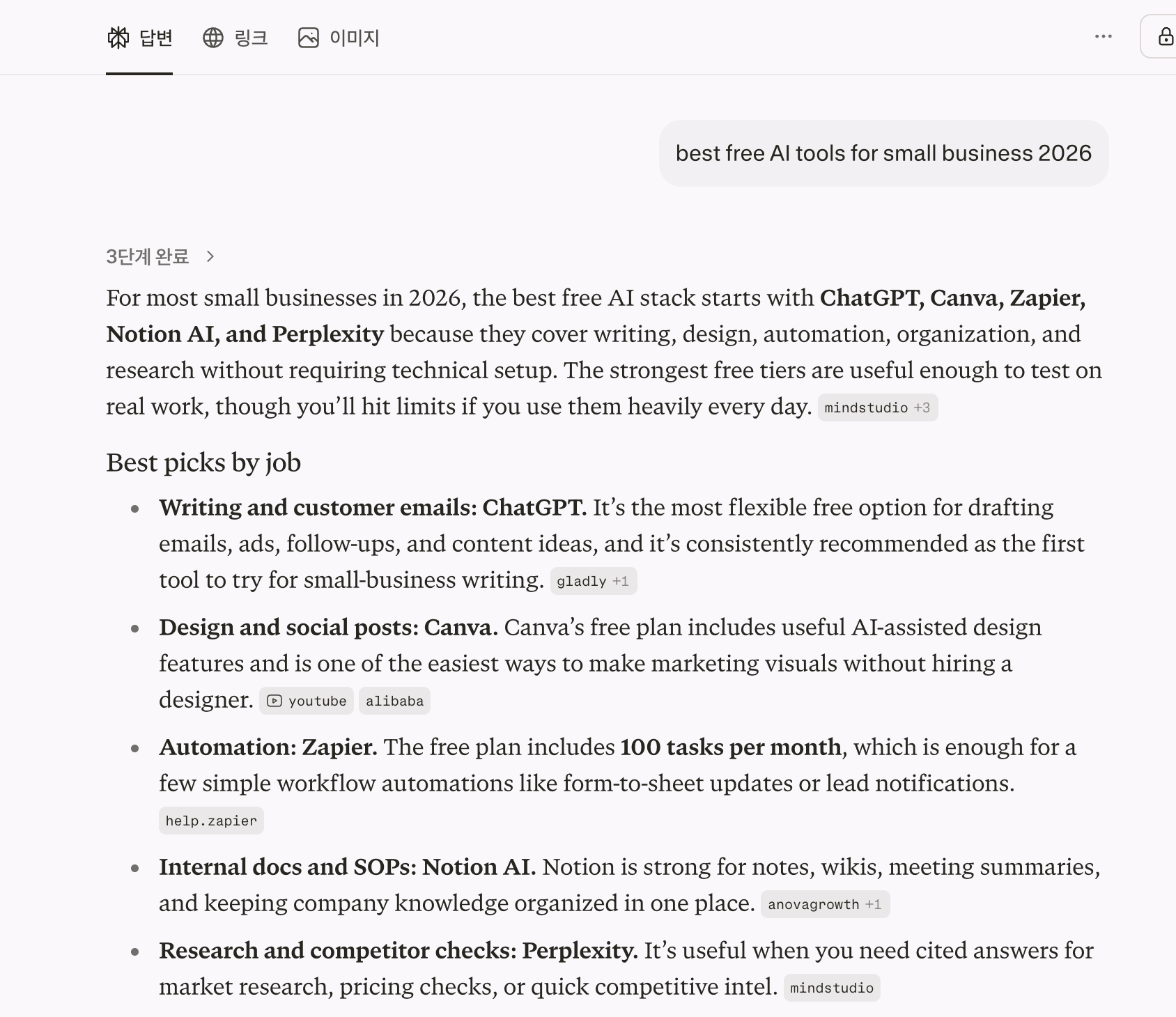
Perplexity opened with a clear thesis paragraph — the best free AI stack for small businesses in 2026 starts with ChatGPT, Canva, Zapier, Notion AI, and Perplexity — followed immediately by a “Best picks by job” section that matched each tool to a use case. Every bullet point ended with an inline citation chip showing which source it came from.
The structure felt deliberately editorial. It wasn’t surfacing links for you to follow — it was synthesizing and presenting a conclusion, then backing it up. The citation chips are less “here’s where to look” and more “here’s the proof for what I just said.”
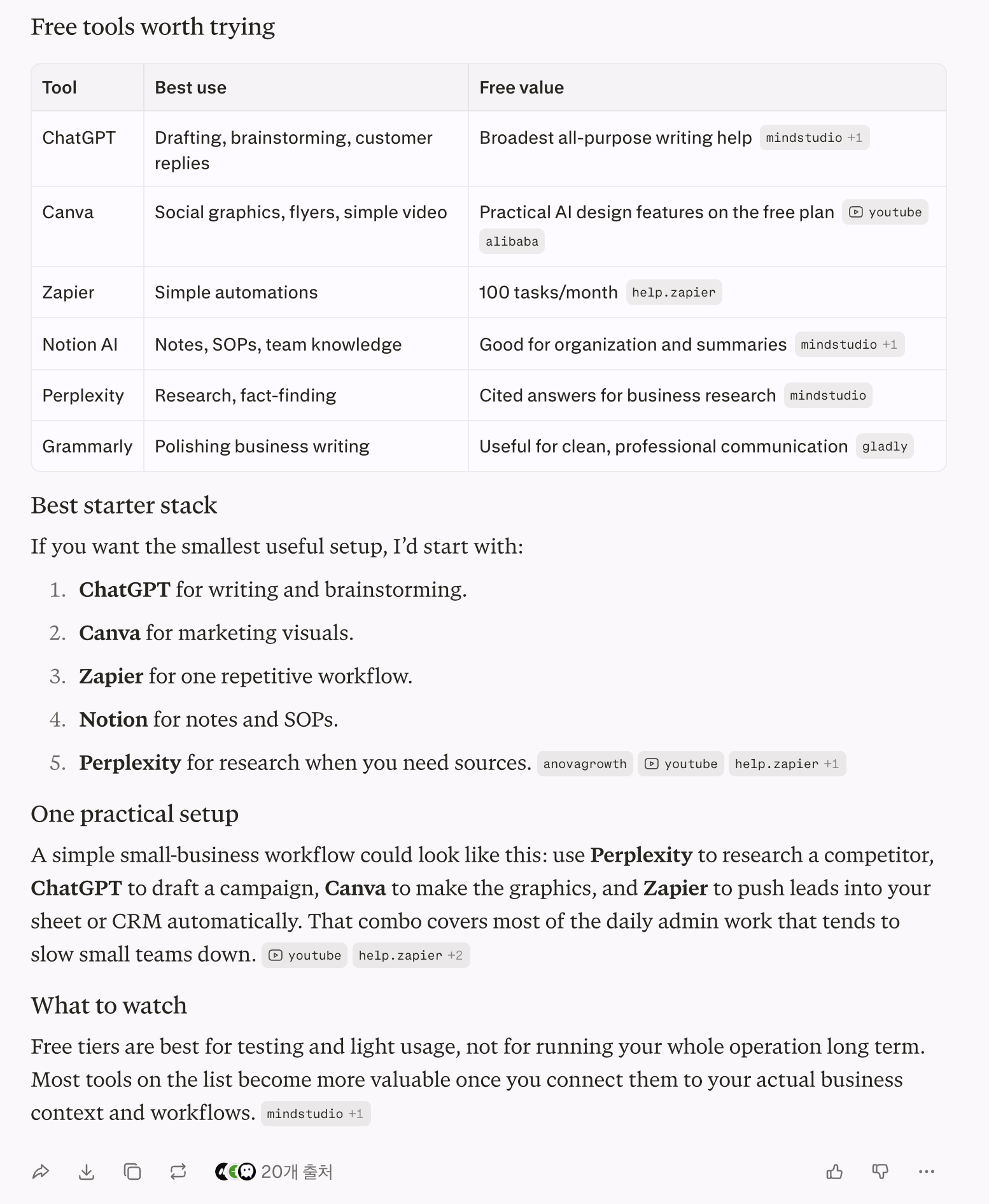
Further down, Perplexity generated a full comparison table — tool, best use, free value — with citations per row. It then ranked a “Best starter stack” as a numbered list, described “One practical setup” as a concrete workflow connecting Perplexity + ChatGPT + Canva + Zapier, and closed with a “What to watch” caveat about free tier limitations.
Total sources cited: 20, shown at the bottom of the response.
The overall impression is what the user described: 논문 느낌 — it reads like a research paper, not a search result. There’s a thesis, evidence, structure, and a conclusion. The citations feel like footnotes.
Perplexity’s Follow-Up Questions
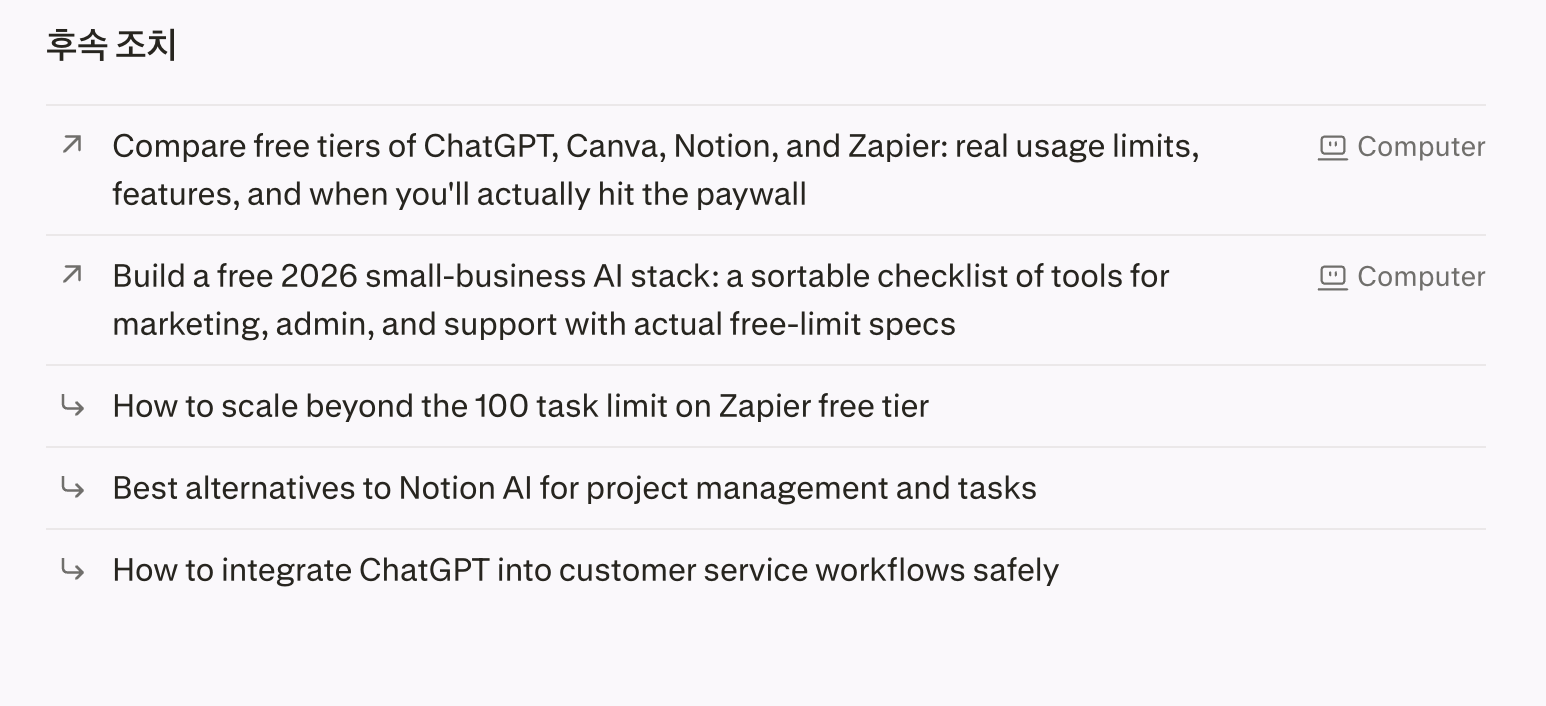
After the answer, Perplexity surfaced five follow-up questions — two labeled “Computer” (implying agentic capability) and three as standard drill-down queries. The suggested questions were genuinely useful next steps rather than generic rephrasing of the original query.
Google AI Overview: 9 Sources, YouTube Embedded
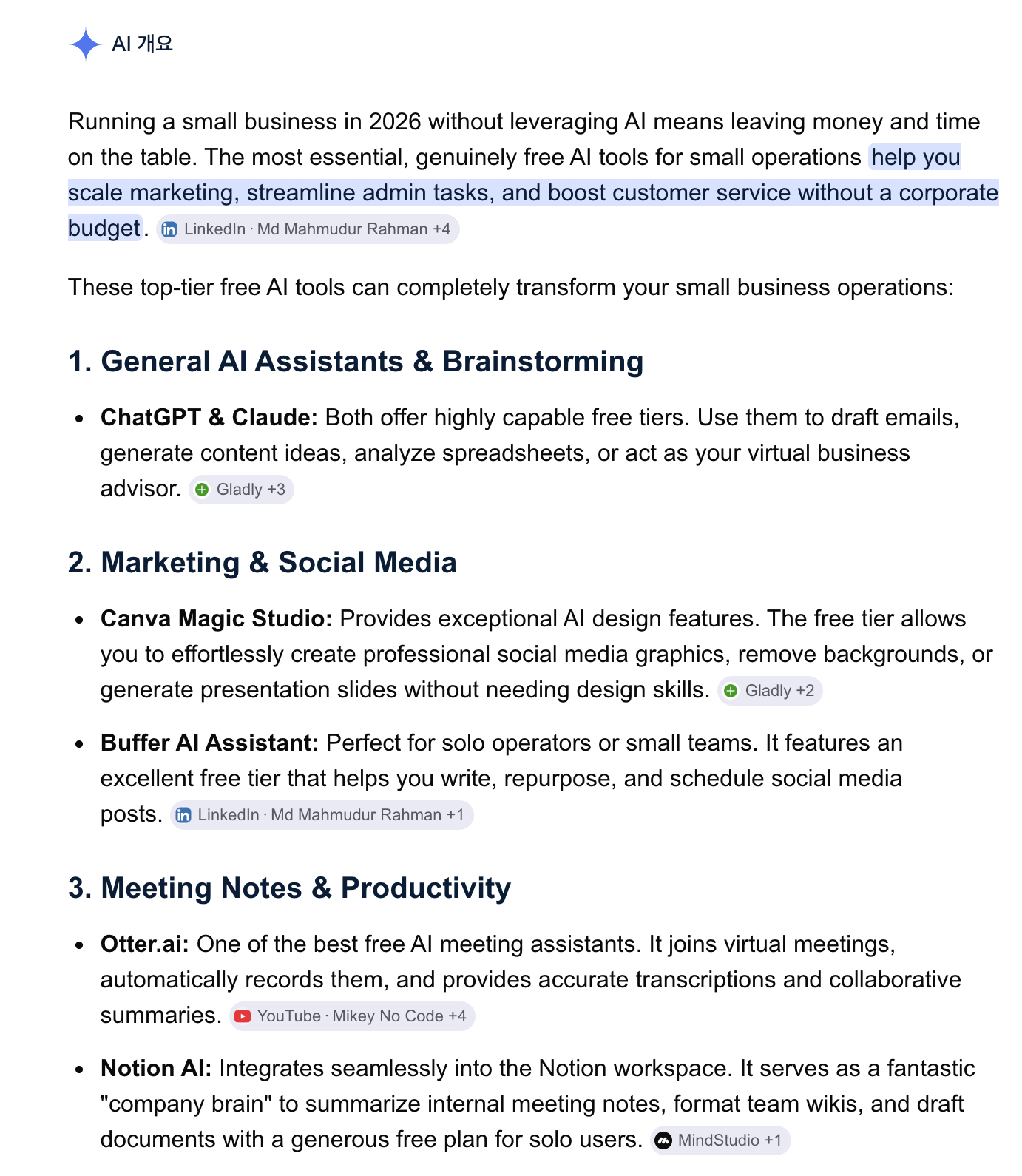
Google’s AI Overview opened with a framing sentence, then moved immediately into numbered sections with headers: General AI Assistants & Brainstorming, Marketing & Social Media, Meeting Notes & Productivity. Each section contained bullet points, and — notably — almost every bullet ended with an inline citation. Not clustered at the end of paragraphs, but embedded after each individual claim.
The sources pulled from a wider variety of content types: LinkedIn posts, YouTube channels, product documentation, and marketing blogs. The inline sourcing felt more like Google’s traditional approach of “here’s what different parts of the web say” translated into prose, rather than Perplexity’s approach of synthesizing a single coherent position.
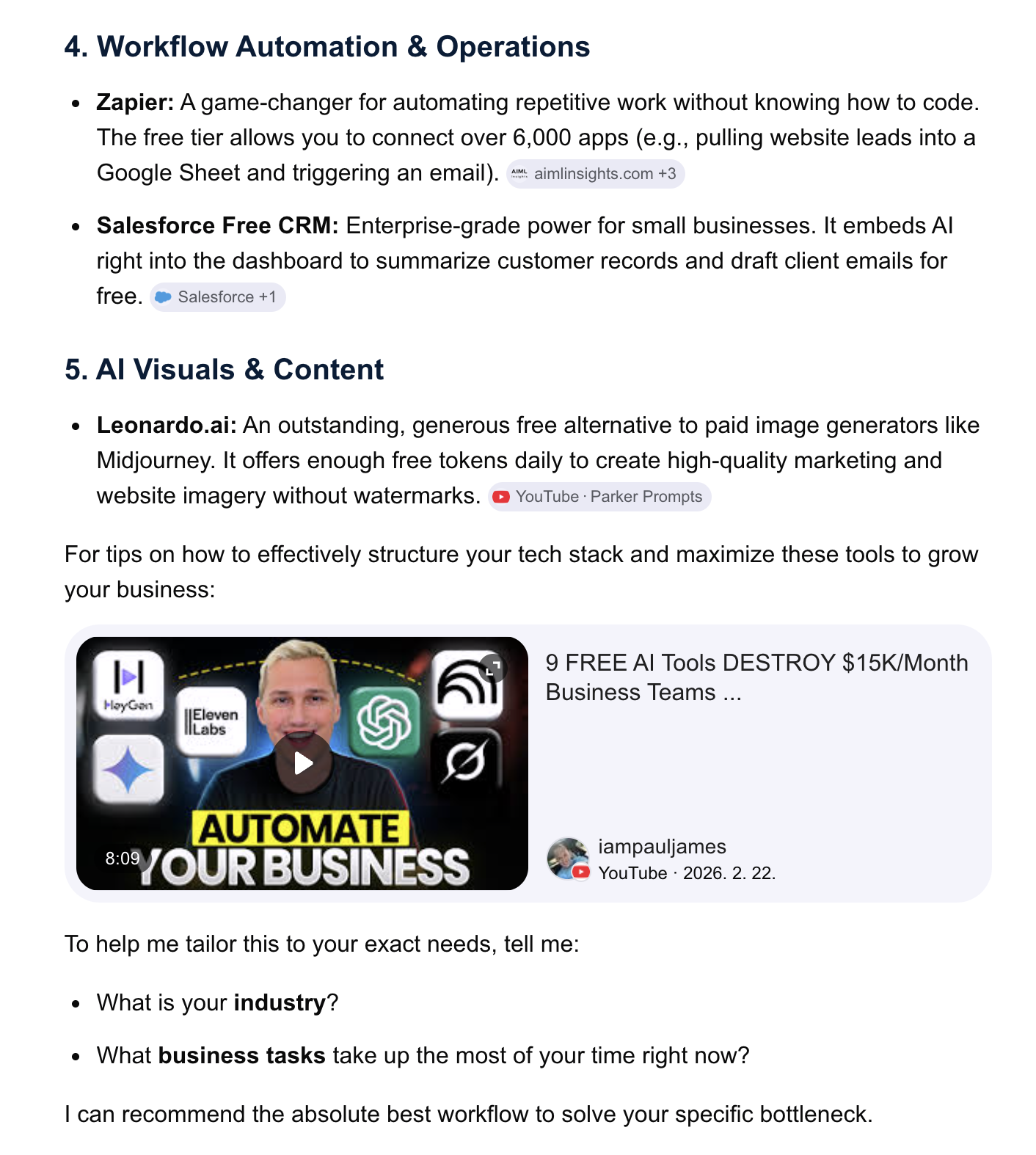
The most distinctive feature: Google embedded a YouTube video directly in the answer body — a thumbnail for a video titled “9 FREE AI Tools DESTROY $15K/Month Business Teams” from iampauljames. This is something Perplexity doesn’t do. Google’s AI Overview doesn’t just know about YouTube content — it surfaces it as a first-class result within the answer itself, which makes sense given that YouTube is a Google property and YouTube search is a significant part of how people research tools.
Total sources cited: 9.
The overall impression: 검색 강자 — the structure and sourcing approach feels like Google Search that has learned to write paragraphs. The per-paragraph citation density is high, the content is useful, and the YouTube integration is a real differentiator.
Both Tools Suggested the Same Follow-Up Questions
One surprising finding: both Perplexity and Google AI Overview proposed nearly identical follow-up question sets. Both surfaced variations of:
- Compare the free tiers of these tools
- How to build a complete free AI stack for a specific business type
- How to integrate these tools into actual workflows
This convergence isn’t coincidental — it reflects what the underlying models identify as the logical next steps after a “best tools” query. The practical implication: if you ask the same initial question to both tools and then follow the suggested next questions, you’ll end up in roughly the same research territory. The path differs more than the destination.
Side-by-Side Comparison
| Perplexity AI | Google AI Overview | |
|---|---|---|
| Total sources cited | 20 | 9 |
| Citation placement | Inline chips after each claim | Per-paragraph, per-bullet |
| YouTube content | Text references only | Embedded video thumbnail |
| Structure | Paper-like (thesis → evidence → conclusion) | Search-like (sectioned, multi-source) |
| Comparison table | Yes (generated) | No |
| Workflow recommendation | Yes (explicit, concrete) | No |
| Follow-up questions | Yes (5, including 2 agentic) | Yes (similar content) |
| Tone | Authoritative, editorial | Informational, aggregated |
What This Means in Practice
Perplexity’s 20-citation approach is better when you need a defensible answer — one you can trace back to sources before acting on it. The paper-like structure means you get a synthesized conclusion first, and the evidence trail if you want to verify. For business decisions where you’ll need to explain your reasoning, Perplexity’s format maps better to how you’d write a recommendation memo.
Google’s YouTube integration is better when the best answer to your question lives in video format — tool tutorials, walkthroughs, demos. For “how does this actually work in practice,” YouTube content often outperforms written guides, and Google surfaces it automatically within the AI answer rather than requiring a separate search.
Neither is universally better. They’re optimized for different information consumption styles. Perplexity assumes you want to read and verify. Google assumes you want to browse and discover. Both assumptions are correct — depending on the day and the question.
The Honest Caveat
Both tools can be confidently wrong. A 20-citation answer from Perplexity and a 9-citation answer from Google are both generated text — the citations reduce the risk of fabrication but don’t eliminate it. Tool pricing, free tier limits, and feature availability change frequently, and neither AI is guaranteed to reflect the current state of a product’s pricing page.
For any decision that involves signing up for or paying for a tool, verify the pricing directly on the product’s website before committing. The AI answer is a starting point for research, not the endpoint.
Conclusion
The Perplexity vs Google AI Overview comparison isn’t really about which tool is smarter. It’s about which format matches how you think when you’re searching.
If you want a synthesized recommendation backed by traceable sources — a research brief you can act on — Perplexity’s 20-citation, paper-structured output is the better fit. If you want a broad survey of what the web says, including video content, with citations woven into every claim — Google AI Overview’s approach feels more familiar and covers more content types.
The fact that both tools proposed the same follow-up questions suggests the underlying reasoning is more similar than the presentation. The difference is interface, not intelligence.
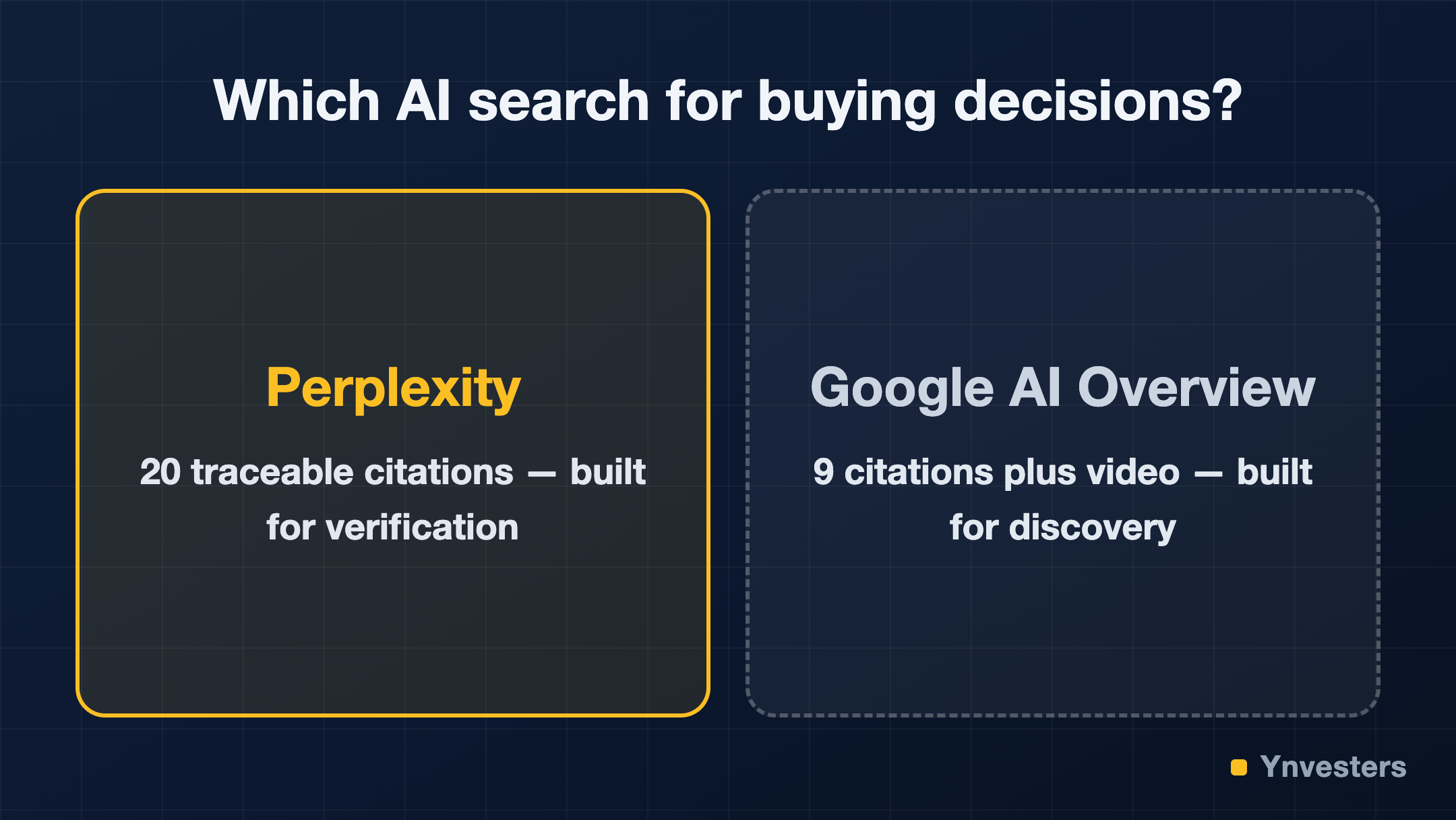
Our take: when the search costs you money, default to Perplexity. For buying decisions — which tool to subscribe to, what a plan actually includes — 20 traceable citations you can verify beat 9 citations woven into prose you’ll skim. Keep Google AI Overview for what it’s genuinely better at: broad discovery, video-inclusive browsing, and questions where being roughly right is enough. Different reach-for defaults, same searcher.
Frequently Asked Questions
Is Perplexity AI better than Google AI Overview?
Neither is universally better — they serve different needs. Perplexity is the stronger fit when you need a defensible, traceable recommendation (it produced 20 inline-cited sources and a structured research-brief format). Google AI Overview is better for broad discovery and questions where video content adds value, since it embeds YouTube results directly in the answer.
Perplexity vs Google AI Overview: which should I use for a buying decision?
The article recommends defaulting to Perplexity for buying decisions. Its 20 traceable citations you can verify beat Google's 9 citations woven into prose — important when a wrong answer costs you money. For either tool, always verify current pricing directly on the product's website before committing.
How many sources does Perplexity AI cite compared to Google AI Overview?
In the article's side-by-side test on the same query, Perplexity cited 20 sources with inline citation chips after each individual claim, while Google AI Overview cited 9 sources embedded per paragraph and per bullet point.
Does Google AI Overview show YouTube videos in its answers?
Yes — Google AI Overview embedded a YouTube video thumbnail directly in the answer body, something Perplexity did not do. The article identifies this as Google's most distinctive feature and a genuine advantage for queries where walkthroughs or demos provide the best answer.