Copy.ai vs Writesonic in 2026: One Is Clearly Better for Solo Creators
Copy.ai vs Writesonic compared for solo creators in 2026. We break down pricing, features, and limits so you know exactly where to spend your $20–60/month.
You’ve got one AI writing subscription slot in your budget — maybe two if you’re generous with yourself — and both Copy.ai and Writesonic keep appearing on every “best AI tools” list you find. They look almost identical from the outside: both generate copy, both use large language models, both promise to save you hours a week. So you open both free trials, poke around for twenty minutes, and still can’t tell which one is actually built for someone working alone.
That’s the exact question this comparison answers.
Q: What is each tool actually designed to do?
Copy.ai started as a short-form copy generator — think Facebook ad headlines, product descriptions, email subject lines, and Instagram captions. Its template library is deep in those formats, and the interface is built around quick, single-output generation. Over time it has expanded toward workflow automation, particularly for sales and marketing teams, with features like Copy.ai’s GTM AI Platform positioning it as a pipeline tool rather than a pure writing assistant.
Writesonic launched with similar short-form DNA but deliberately pushed into long-form territory early. Its Article Writer tool, Chatsonic (a conversational AI layer with web access), and integrations with SEO platforms make it a broader content production suite. Visit writesonic.com to see its current feature set — it has expanded considerably and the positioning is clearly aimed at content marketers and bloggers who need to publish consistently.
The honest summary: Copy.ai is sharpening its focus toward B2B sales teams. Writesonic is doubling down on individual content creators and small marketing operations.
Q: How do the pricing structures compare for a solo user?
This is where the decision gets concrete. Pricing changes frequently, so verify both on their official pages before subscribing — but here is the structure as of mid-2026:
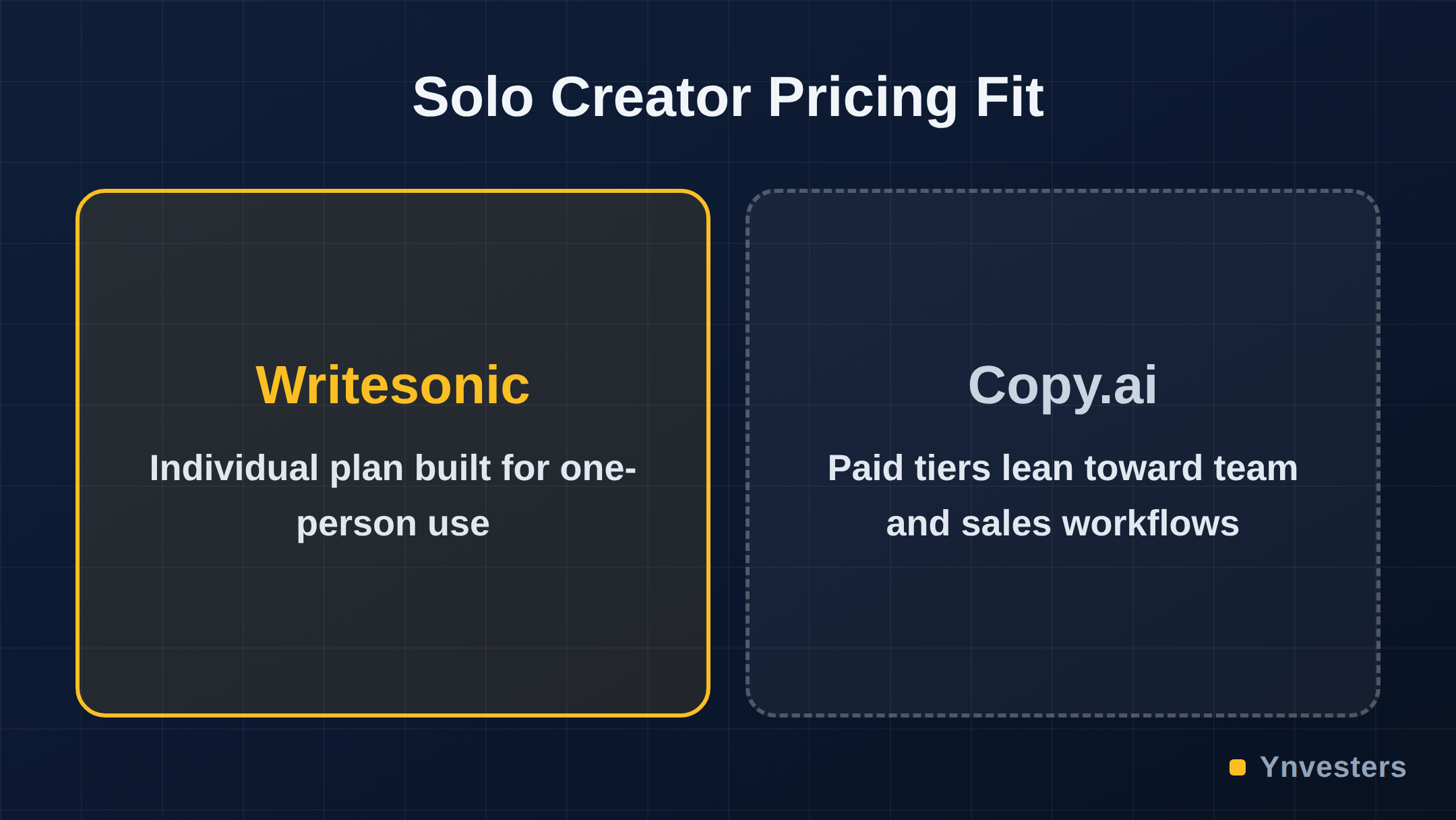
Copy.ai offers a free plan with a credit limit per month. Its paid plans have historically been structured around seats and team features, meaning a solo user pays for infrastructure they can’t fully use. The individual upgrade cost becomes harder to justify when many of the premium features — bulk workflows, team workspaces, CRM integrations — are irrelevant to a single freelancer.
Writesonic offers an individual paid tier that is genuinely aimed at one person. Features like Chatsonic, the long-form article generator, and SEO tools are available without requiring you to buy a team seat. Check writesonic.com/pricing for exact current figures; pricing has shifted as the product matured.
Q: Which tool produces better long-form content?
Writesonic, clearly.
Its Article Writer offers multiple generation modes — you can go from a keyword to a structured draft with headings, meta descriptions, and internal link suggestions in a single workflow. The output quality depends heavily on your prompt quality, as with any LLM-based tool, but the scaffolding around the model (outline generation, fact-checking prompts, SEO keyword density guidance) meaningfully reduces the editing burden.
Copy.ai does have a long-form editor, but it is not the product’s core strength. The experience feels like a short-form tool that was extended, rather than a long-form tool built from the ground up. For a solo blogger who needs to publish a 1,500-word SEO article twice a week, that distinction matters every single time you open the editor.
Writesonic’s integration with Surfer SEO (verify current availability on Writesonic’s site) is a meaningful differentiator — it allows you to optimize content against top-ranking pages without leaving the writing interface. For a freelancer managing their own content strategy, that saves a real context-switch.
Q: What about short-form copy — ads, emails, social posts?
This is Copy.ai’s home turf, and it shows. The template library for short-form formats is extensive, the interface for generating multiple variations quickly is clean, and the friction between “I need five headline options” and actually having them is low.
Writesonic covers these formats too — it has ad copy templates, email generators, and social caption tools — but the UX for rapid short-form iteration is not as refined. If your primary output is performance marketing copy (Google Ads, Meta Ads, cold email sequences), Copy.ai’s workflow will feel more natural.
The important caveat: Copy.ai’s free plan covers a lot of short-form use cases. If you’re a solo creator whose AI writing needs are mostly captions and subject lines, you may not need to pay for either tool — Copy.ai’s free tier could be sufficient.
Q: Does Writesonic’s Chatsonic feature matter for solo creators?
More than most reviews acknowledge. Chatsonic is Writesonic’s conversational AI interface, similar in feel to ChatGPT but with web access enabled by default and a publishing workflow built in. For a solo creator, this means you can research, draft, and refine within one tool rather than tabbing between a browser, a chat interface, and your writing environment.
OpenAI’s ChatGPT remains the dominant conversational AI, but if you’re already paying for a Writesonic subscription, having a capable web-connected chat layer included — rather than as a separate $20/month add-on — changes the value calculation.
Q: What are the real limitations of each tool?
Writesonic limitations:
- AI-generated long-form content still requires substantive editing for accuracy, especially on technical topics. Do not publish without a fact-check pass.
- Pricing tiers have changed multiple times; word/credit limits can feel restrictive on lower plans during heavy production weeks.
- The interface has more surface area than Copy.ai, which means a steeper learning curve for new users.
Copy.ai limitations:
- The platform’s pivot toward enterprise GTM workflows means solo creator features are not the development priority. New features are increasingly team-oriented.
- Long-form output quality lags behind Writesonic for structured article production.
- The gap between the free plan and a useful paid plan can feel abrupt for users who outgrow credits.
Q: How do the two tools compare side by side?
| Feature | Writesonic | Copy.ai |
|---|---|---|
| Long-form article generator | Strong, dedicated workflow | Basic, not a core feature |
| Short-form copy templates | Available, less refined UX | Extensive, polished |
| Conversational AI (web access) | Chatsonic included | Limited on base plans |
| SEO integration | Surfer SEO integration (verify current) | Not a primary feature |
| Free plan | Limited free access | Generous free tier for short-form |
| Pricing structure for solo users | Individual plan available | Scales toward team seats |
| Best for | Solo bloggers, content marketers | Ad copywriters, sales teams |
Conclusion
Our take: Writesonic is the better subscription for most solo creators in 2026. If you publish blog posts, SEO articles, or any content longer than a few hundred words on a regular schedule, Writesonic’s individual plan gives you the tools to do that without paying for team infrastructure you’ll never use. The Chatsonic layer and SEO integration alone justify the comparison against paying separately for ChatGPT Plus and a standalone SEO tool.
Copy.ai is the right choice in one specific scenario: you primarily generate short-form copy — ads, captions, email subject lines — and the free plan covers your volume. In that case, don’t pay for either tool at the paid tier. Use Copy.ai free and put the subscription money elsewhere.
Who should skip both? If you’re already on a ChatGPT Plus or Claude Pro plan and are comfortable with prompting, a dedicated copy tool may duplicate what you already have. Evaluate that before adding another $20–40/month to your stack.

Before subscribing to either, check current pricing directly: writesonic.com/pricing and copy.ai/pricing. Both have adjusted their plans as the market has matured, and the exact credit limits and tier boundaries matter more than the brand names.
Frequently Asked Questions
Is Writesonic worth it for solo creators in 2026?
Yes, for creators who publish blog posts, SEO articles, or long-form content regularly. Writesonic's individual plan bundles an AI writer, Chatsonic, and SEO integrations at a price point competitive with standalone tools. Check writesonic.com for current pricing before subscribing.
Is Copy.ai free to use?
Copy.ai does offer a free tier with a limited number of credits per month, which covers short-form copy tasks. Its paid plans are primarily designed for teams, so solo users often find the jump in price hard to justify compared to alternatives.
How does Writesonic compare to Copy.ai for long-form content?
Writesonic is the stronger tool for long-form work. It offers article generators, an AI Article Writer with multiple draft modes, and SEO-focused features that Copy.ai does not replicate at the same depth on individual plans.
Which is better for ad copy — Copy.ai or Writesonic?
Copy.ai has historically been strong for short-form ad copy, social captions, and email subject lines, with a template library built around those formats. Writesonic covers these formats too but its clearest differentiation is in longer content.