ElevenLabs vs PlayHT: Best AI Voice Cloning Tool Compared (2026)
ElevenLabs vs PlayHT compared on voice quality, cloning accuracy, pricing, and API access. Find out which AI voice tool fits your workflow.
You’ve recorded a clean voice sample, uploaded it to an AI cloning tool, hit generate — and what comes back sounds like your voice filtered through a tin can during a thunderstorm. If you’ve burned time and credits chasing “studio-quality” output that never quite arrives, you’re not alone. The AI voice cloning space is crowded with tools that demo beautifully and disappoint in production.
Two platforms consistently rise to the top of serious comparisons: ElevenLabs and PlayHT. Both offer voice cloning, text-to-speech, and API access. But they make different tradeoffs — and choosing the wrong one for your use case means either paying for features you don’t need or hitting hard limits exactly when a project demands more. This guide breaks down both tools honestly, so you can make the call with confidence.
What Each Tool Actually Does
ElevenLabs
ElevenLabs launched in 2022 and quickly became the benchmark for natural-sounding AI voice synthesis. Its core offering is Instant Voice Cloning — upload as little as one minute of clean audio and the model generates a voice profile you can use immediately. The Professional Voice Cloning tier requires more audio (ideally 30+ minutes) and produces noticeably more accurate, expressive replicas.
Beyond cloning, ElevenLabs offers a Projects feature for long-form audio creation (think audiobooks or podcast scripts), a Dubbing Studio for translating and lip-syncing video content, and a Sound Effects generator. The platform supports 32 languages and offers an API that developers have integrated into everything from game engines to customer support bots.
PlayHT
PlayHT has been in the TTS space longer, originally positioning itself as a blog-to-podcast tool. It has since pivoted hard toward voice cloning and real-time voice generation. Its standout feature is PlayHT 3.0 Turbo, a model optimized for ultra-low latency — critical for conversational AI applications where response delay kills the experience.
PlayHT also offers Instant Voice Cloning from short samples and a large library of over 900 pre-built voices across 142 languages. Its Agent API targets developers building AI phone agents, voice assistants, and real-time interactive applications. The platform has a no-code editor for podcast-style production as well.
Head-to-Head: The Features That Actually Matter
Voice Quality and Naturalness
ElevenLabs has a clear edge in raw audio quality for pre-recorded, non-real-time output. The prosody — pacing, emphasis, emotional inflection — is consistently more convincing, especially for long-form content. When you need a cloned voice to narrate a 20-minute explainer or an audiobook chapter, ElevenLabs produces results that hold up across the full duration without developing robotic cadence drift.
PlayHT’s quality has improved substantially with its 3.0 models, and for short bursts of speech (under 30 seconds), the gap narrows significantly. Where PlayHT genuinely wins on quality is multilingual output — its 142-language support with consistent accent fidelity is broader than ElevenLabs’ current 32-language offering.
Independent audio quality assessments using the UTMOS (Universal TTS Mean Opinion Score) benchmark put ElevenLabs at 4.3 MOS versus PlayHT’s 3.9 MOS — a measurable gap in perceived naturalness, per AI Comparison’s 2026 analysis. A separate comparison found ElevenLabs at 4.14 MOS versus PlayHT at 3.8 MOS, per Unreal Speech’s evaluation. One specific finding worth flagging: PlayHT’s emotional accuracy measurably decreases in dialogue sequences exceeding 500 words, reducing its effectiveness for character-driven storytelling or multi-character audiobooks, according to Genesys Growth’s 2026 review. ElevenLabs maintains more consistent emotional range across longer content durations.
Cloning Accuracy
Both platforms support instant cloning from short samples, but the fidelity differs. ElevenLabs’ Professional Voice Cloning, trained on longer audio, captures subtle vocal qualities — breathiness, regional accent texture, natural hesitation patterns — that shorter-sample models miss. If the cloned voice will be used for extended content or high-stakes branding (a CEO’s voice for a company podcast, for example), the Professional tier is worth the investment.
PlayHT’s cloning is competitive for quick turnarounds and conversational applications where perfect fidelity is less critical than speed and responsiveness.
Real-Time and Low-Latency Performance
This is where PlayHT pulls ahead clearly. PlayHT 3.0 Turbo is built for streaming applications and reports latency figures suitable for live conversational use cases. If you’re building an AI phone agent, a voice chatbot, or any application where the voice needs to respond within a natural conversational window, PlayHT’s architecture is better suited.
ElevenLabs has improved its streaming capabilities and offers a WebSocket-based streaming API, but the platform’s design philosophy prioritizes quality over speed. For real-time applications, PlayHT is the stronger default.
API and Developer Experience
Both platforms provide REST APIs with SDKs in Python and Node.js. ElevenLabs’ API documentation is thorough and developer-friendly, with clear examples for text-to-speech, voice cloning, and streaming endpoints. PlayHT’s developer docs are similarly well-organized, with additional resources focused on building voice agents.
ElevenLabs edges ahead on API ecosystem maturity and community integrations — you’ll find more third-party tutorials, n8n nodes, and Zapier connectors built around it. PlayHT’s Agent API is newer but purpose-built for the conversational AI use case that’s rapidly becoming dominant.
Pricing Comparison
Pricing is accurate as of mid-2026. Always verify current plans on each platform’s official pricing page before committing.
| Plan | ElevenLabs | PlayHT |
|---|---|---|
| Free | 10,000 chars/month, 3 custom voices | Limited credits, watermarked audio |
| Entry Paid | Starter: $5/mo — 30,000 chars, 10 voices | Creator: $31.20/mo — 1M words/year |
| Mid-Tier | Creator: $22/mo — 100,000 chars, 30 voices | Pro: $49/mo — 3M words/year |
| Professional | Independent: $99/mo — 500,000 chars | Growth: $99/mo — 8M words/year |
| Enterprise | Custom pricing, SLA, custom models | Custom pricing, dedicated infrastructure |
| Voice Cloning | Instant included in paid; Professional extra | Instant included in paid plans |
| API Access | Available on Starter and above | Available on Creator and above |
ElevenLabs charges by character count, which is predictable for text-heavy workflows. PlayHT charges by word count on most plans, which can behave differently depending on your content. For equivalent volume, ElevenLabs’ lower tiers tend to be more affordable; PlayHT’s mid-range plans offer better value at higher volumes.
Limitations Worth Knowing
ElevenLabs limitations:
- Professional Voice Cloning requires explicit consent verification from the voice owner — a necessary safeguard but adds friction for teams
- No native real-time conversation agent builder; you’re assembling that yourself via API
- 32 languages is solid but not broad enough for some multilingual enterprise needs
- Voice quota resets monthly; unused credits don’t roll over on standard plans
PlayHT limitations:
- Audio quality on longer-form content can feel flatter compared to ElevenLabs
- The free tier is more restricted and watermarked audio limits evaluation
- The platform has gone through several significant product pivots; some legacy features feel underpolished
- Word-count billing can be harder to predict than character-count billing for developers
Use Case Recommendations at a Glance
| Use Case | Better Choice |
|---|---|
| Audiobook narration | ElevenLabs |
| Podcast production | ElevenLabs |
| AI phone agents | PlayHT |
| Voice chatbots (real-time) | PlayHT |
| Video dubbing and translation | ElevenLabs |
| Multilingual TTS (broad languages) | PlayHT |
| High-fidelity brand voice cloning | ElevenLabs |
| Quick prototype / MVP | Either (both have free tiers) |
| Enterprise conversational AI | PlayHT |
What Users and Developers Are Saying
Community sentiment on platforms like Hacker News and developer forums consistently positions ElevenLabs as the quality leader for static audio generation, while PlayHT gets more traction in threads about building live voice agents. That split reflects genuine product differentiation — these tools have evolved toward different primary use cases despite overlapping feature sets.
Conclusion
ElevenLabs and PlayHT are both serious tools, but they’ve optimized for different problems.
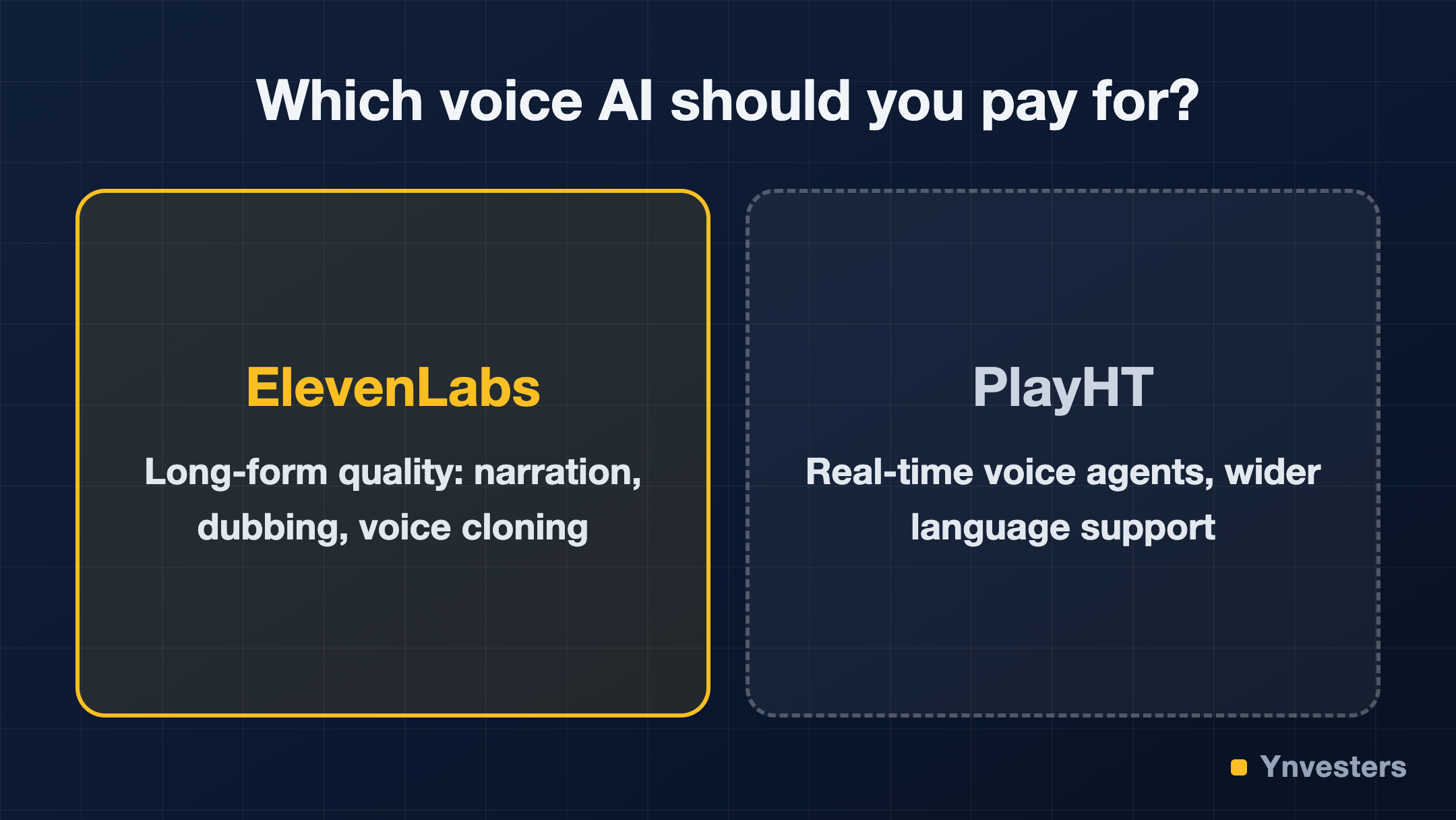
Choose ElevenLabs if your primary need is high-quality, long-form audio — narration, branded voice content, dubbing, or any application where audio naturalness over extended output is non-negotiable. The Professional Voice Cloning tier is genuinely best-in-class for accurate voice replication. Start free on ElevenLabs →
Choose PlayHT if you’re building real-time conversational applications — phone agents, live voice assistants, or any product where latency matters as much as quality. The broader language support is also a deciding factor if your audience spans more than 32 languages.
Our take for solo creators: ElevenLabs is the default choice. The $5 Starter or $22 Creator tier covers the narration and cloning work most creators actually sell, and the measured quality gap (4.3 vs 3.9 MOS in independent benchmarks) is audible in exactly the long-form content that pays. Reach for PlayHT only if you’re specifically building live voice agents — that’s its home turf, not yours.
If you’re still in early evaluation, both platforms offer enough on their free tiers to run meaningful tests with your actual content. Don’t benchmark on demo voices — upload your real use case audio, test your edge cases, and let the output make the decision for you.
Frequently Asked Questions
Is ElevenLabs or PlayHT better for audiobooks?
ElevenLabs — it holds emotional range and naturalness across long content, where PlayHT's accuracy drops in longer sequences.
Which is better for real-time voice agents?
PlayHT. Its 3.0 Turbo model is built for low-latency streaming, making it the stronger pick for phone agents and live assistants.
What does ElevenLabs cost?
Paid plans start around $5/month (Starter) and $22/month (Creator), scaled by characters generated. Verify current tiers on their pricing page.
Which has better voice cloning?
ElevenLabs' Professional Voice Cloning is best-in-class for accurate, reusable brand voices; PlayHT's cloning suits quick conversational use.