GPT-Live: What It Is, Key Features, and Is It Worth It?
OpenAI's GPT-Live brings a new generation of voice models to ChatGPT. Here's what we know, what's still unclear, and whether it changes your workflow.
You’re mid-task — cooking, commuting, or in the middle of a project where your hands are occupied — and you try to have a real back-and-forth with an AI voice assistant. It stumbles on your question, gives a robotic response, or just stops making sense the moment the conversation gets even slightly nuanced. That friction is exactly the problem OpenAI is trying to solve with its latest announcement.
On July 9, 2026, OpenAI announced GPT-Live, describing it as “a new generation of voice models for natural human-AI interaction, now powering ChatGPT Voice.” That single sentence is, so far, the sum total of what’s officially confirmed. But even with limited detail, the announcement signals a meaningful shift in how OpenAI is positioning voice as a first-class capability — not a feature bolted onto a text-first product.
This article breaks down what we actually know, what remains unconfirmed, and what it means practically if you’re paying for a ChatGPT subscription right now.
What GPT-Live Actually Is (Based on What’s Been Announced)
The phrase “new generation of voice models” does real work in OpenAI’s announcement, even if it’s terse. It implies GPT-Live is not an incremental patch to the existing voice pipeline, but a distinct model architecture purpose-built for spoken conversation. According to the announcement, it now powers ChatGPT Voice — meaning if you use voice mode in ChatGPT today, GPT-Live is what you’re talking to.
OpenAI’s emphasis on “natural human-AI interaction” points toward the core design goal: reducing the mechanical quality that makes AI voice feel like a phone tree rather than a conversation. That involves a range of hard technical problems — latency, turn-taking, prosody (the rhythm and tone of speech), handling interruptions, and maintaining conversational context across a multi-minute exchange.
What we do not yet know from official sources: the specific model size or architecture, latency benchmarks, language support breadth, or how GPT-Live compares quantitatively to its predecessors. Readers who need those specifics should check the OpenAI research index and the official announcement page directly, as those details may be released in follow-up technical posts.
Why Voice AI Is Harder Than It Looks
To understand what OpenAI is attempting, it helps to understand why voice remains the most difficult frontier in consumer AI — even for a company that has already shipped remarkably capable text models.
Text interaction has a built-in mercy: it’s asynchronous. You type, you wait, you read. A half-second delay is invisible. In voice, that same half-second feels like an awkward pause — the kind that makes you wonder if the model heard you or crashed. Human conversation operates on timing signals measured in milliseconds. We interpret a slight delay as hesitation, a missed beat as confusion.
Then there’s interruption handling. Real conversation isn’t sequential — people talk over each other, correct themselves mid-sentence, and change direction abruptly. Voice AI that can’t handle that gracefully forces users into an unnatural, stilted pattern: speak, wait, listen, repeat. That’s not conversation; it’s a command-line interface with audio.
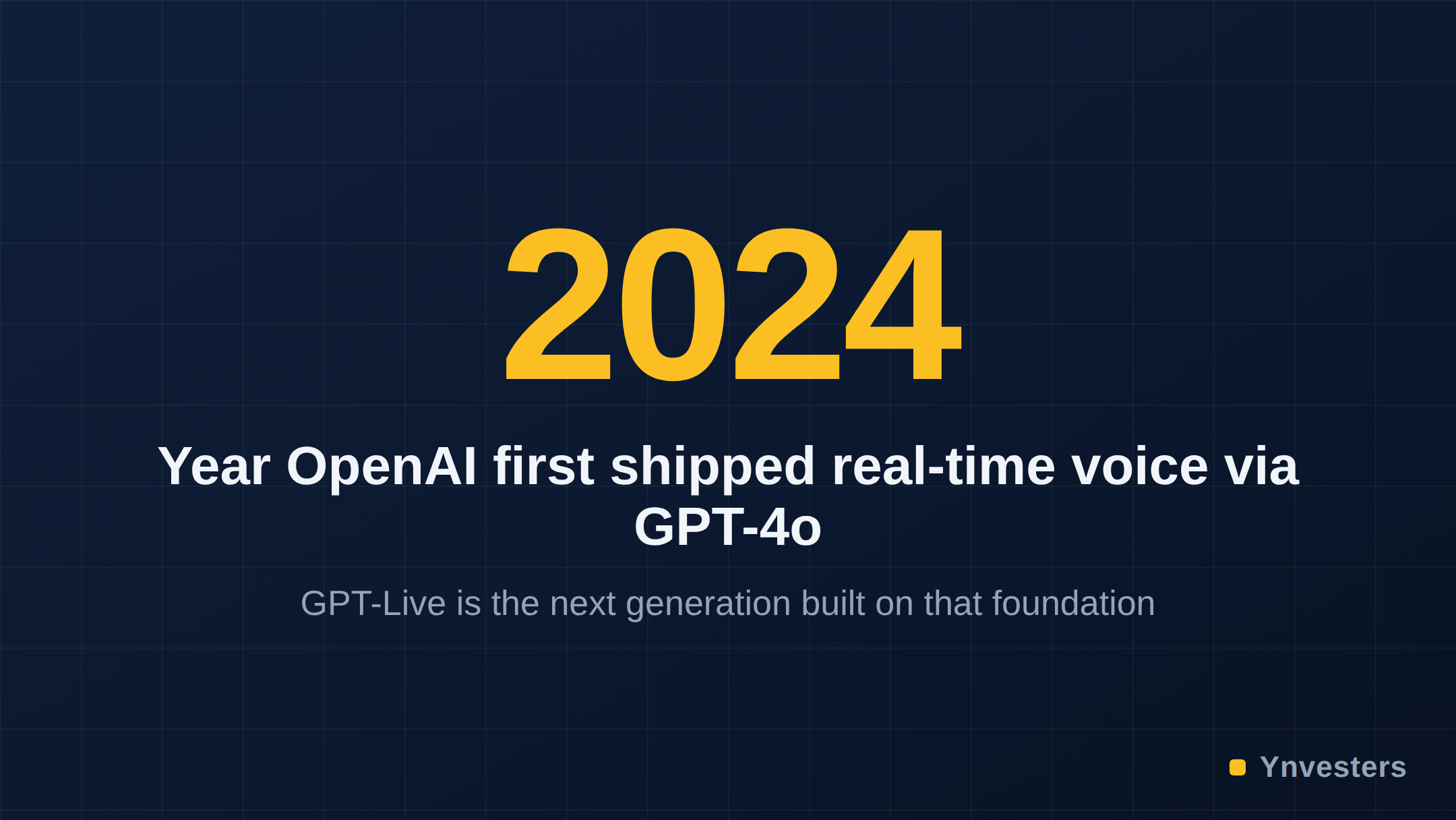
OpenAI has been working on this problem since at least GPT-4o’s introduction in 2024, which brought real-time audio capabilities to ChatGPT for the first time. GPT-Live appears to be the next chapter in that arc — a dedicated voice model rather than a general model adapted for voice.
Key Features — What’s Confirmed vs. What’s Speculative
Given the brevity of the official announcement, it’s important to be precise about what falls into each category.
Confirmed by OpenAI’s announcement:
- GPT-Live is a new generation of voice models (not an update to an existing one)
- It is designed specifically for natural human-AI interaction
- It now powers ChatGPT Voice
Not yet confirmed — details to verify on OpenAI’s site:
- Pricing or whether it requires a higher-tier subscription
- Specific languages supported beyond what current ChatGPT Voice covers
- Technical specifications (latency figures, context window for voice, etc.)
- API availability for developers
- Whether GPT-Live is available globally or in a staged rollout
This is an honest accounting of what’s public. In a market full of breathless launch coverage that fills in the blanks with educated guesses, we think it’s more useful to name the gaps than to paper over them.
How It Fits Into the Competitive Landscape
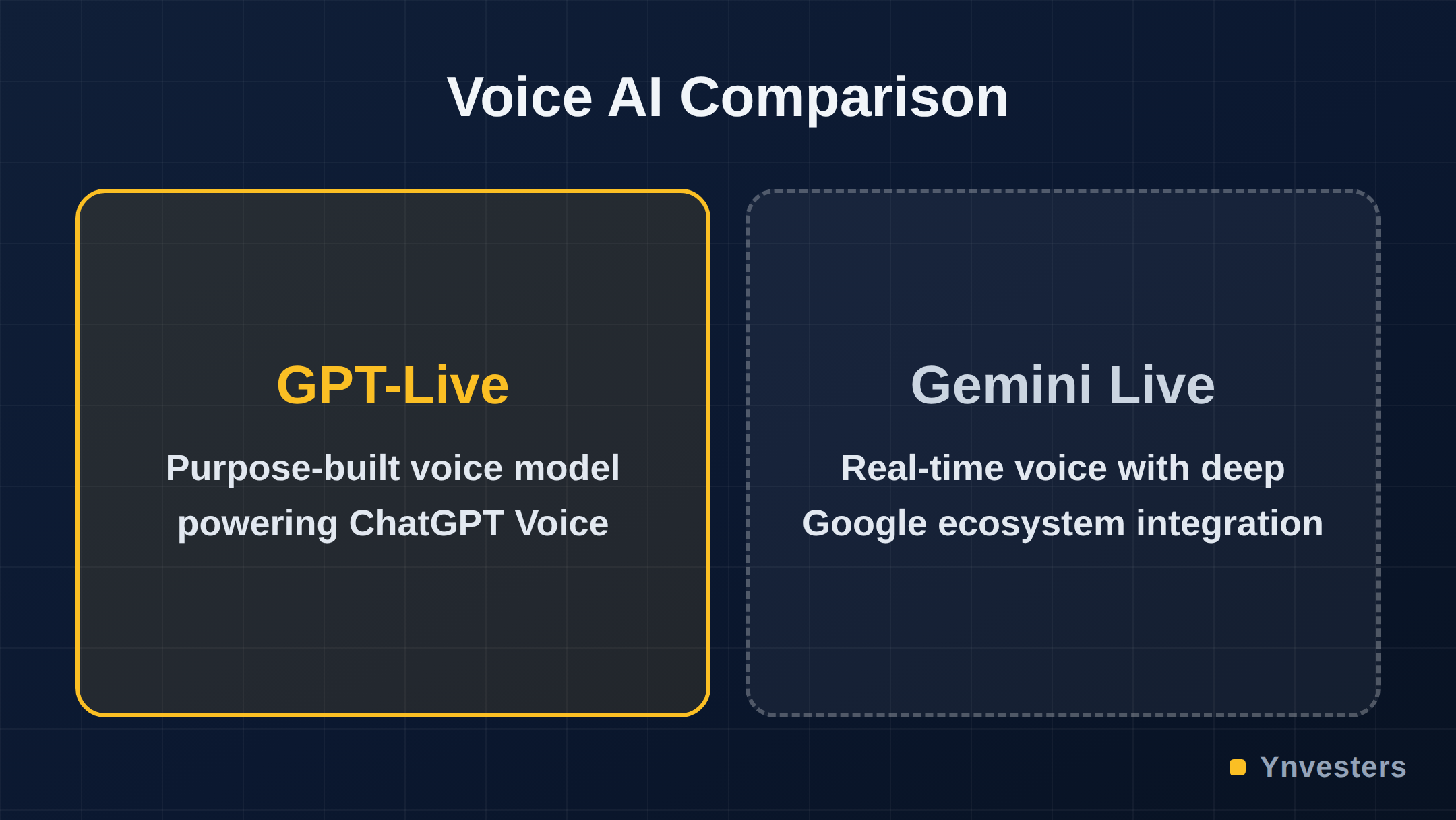
GPT-Live doesn’t exist in a vacuum. OpenAI is competing in a voice AI space that now includes Google’s Gemini Live, which offers real-time voice conversation integrated with Google’s ecosystem, and a range of voice-first startups building on open-source speech models.
The competitive pressure matters because it shapes OpenAI’s urgency here. Gemini Live launched with tight integration into Android and Google Workspace — a meaningful advantage for users already in Google’s ecosystem. For OpenAI to hold its position as the default AI for most independent professionals, ChatGPT Voice needs to be clearly better in quality, not just competitive on availability.
GPT-Live, as framed by OpenAI, is the company’s answer to that challenge: a purpose-built voice model rather than a general-purpose model doing voice on the side.
What This Means If You’re Paying for ChatGPT Right Now
If you’re a solo creator or freelancer on a ChatGPT Plus or Pro subscription, the practical question is straightforward: does this change what you’re getting for your money?
Based on what’s been announced, GPT-Live is integrated into ChatGPT Voice — which means if you already have a paid plan with voice access, you’re likely already using it (or will be soon, depending on rollout timing). There’s no indication from the announcement that GPT-Live is a separate, higher-priced add-on. But that could change — check OpenAI’s pricing page for current plan details before making any decisions.
For users who have tried ChatGPT Voice and found it good-but-not-great — functional for simple queries but frustrating in longer exchanges — GPT-Live is the update worth watching. If the quality gap is as meaningful as the “new generation” framing implies, voice could become a genuinely useful part of a daily workflow rather than an occasional novelty.
For users who’ve never found voice mode compelling — people who prefer to type, review, and edit rather than speak — this announcement changes very little. A better voice model doesn’t create a use case that wasn’t there before.
What We’re Watching For in the Coming Weeks
With any major AI announcement, the delta between the press release and the real-world experience can be significant. Here’s what would actually confirm GPT-Live’s value:
Latency in real conditions. Demo environments are optimized. What matters is how the model performs on a decent home internet connection, not in a controlled test.
Handling of complex, multi-turn conversations. Can GPT-Live maintain context and coherence across a ten-minute back-and-forth on a technical topic? That’s the bar text-based ChatGPT clears comfortably in its best moments.
Naturalness under pressure. Interruptions, topic switches, and self-corrections are where previous voice AI has stumbled. Real-world user reports — not curated demos — will tell the story here.
Developer API access. If OpenAI releases GPT-Live via API, third-party developers can build on it, and we’ll get a much broader signal about its real capabilities from the apps that use it.
We’ll be revisiting this analysis once independent testing and user reports accumulate. For now, treat the announcement as a signal of direction, not a confirmed feature set.
Conclusion
GPT-Live is a meaningful signal from OpenAI: voice is no longer a secondary feature riding on top of a text model. According to OpenAI’s announcement, it’s a purpose-built voice architecture now at the center of ChatGPT Voice. That matters strategically — and it may matter practically for users whose workflows already involve voice interaction.
Our take: if voice is already part of how you use ChatGPT, pay attention to GPT-Live — but wait for independent reviews before changing your subscription based on it. If you’re text-first, this announcement doesn’t move the needle for you yet.
What would change our assessment: published latency benchmarks, real-world user testing that confirms the quality jump implied by “new generation,” and clarity on whether higher-tier plans unlock meaningfully better voice performance. Until those details surface, GPT-Live is a promising architectural shift, not yet a proven reason to spend more.

For the most current information on features and pricing, go directly to the official GPT-Live announcement and OpenAI’s pricing page — both of which will reflect any updates OpenAI makes as the rollout progresses.
Frequently Asked Questions
What is GPT-Live?
GPT-Live is OpenAI's new generation of voice models built for more natural human-AI interaction. According to OpenAI's announcement, it now powers ChatGPT Voice, replacing or supplementing the previous voice infrastructure.
How much does GPT-Live cost?
OpenAI has not announced specific pricing for GPT-Live as a standalone product. It appears to be integrated into ChatGPT, so access likely depends on your existing ChatGPT plan — check OpenAI's pricing page for current details.
Is GPT-Live worth it for freelancers and solo creators?
If you rely on voice interaction to draft content, brainstorm hands-free, or conduct research while multitasking, GPT-Live could add real value. If your workflow is text-first, the upgrade is unlikely to justify changing your subscription tier.
How is GPT-Live different from the existing ChatGPT Voice mode?
According to OpenAI's announcement, GPT-Live represents a new generation of voice models — implying improved naturalness over previous voice features. Specific technical differences have not been detailed publicly yet.