OpenAI Presence: What It Is, Key Features, and Is It Worth It?
OpenAI Presence is a new enterprise AI agent platform for voice and chat workflows. Here's what we know, what's missing, and who should care.
You’ve watched the AI agent hype cycle long enough to know the pattern: a company announces a “platform,” the landing page is full of enterprise buzzwords, and by the time you figure out whether it applies to your work, three more announcements have dropped. If you’ve felt that exhaustion, OpenAI’s latest announcement will feel familiar — and this time, it’s worth paying careful attention anyway.
OpenAI has just announced OpenAI Presence, described as “a proven enterprise AI agent platform that helps organizations deploy trusted voice and chat agents for customer and internal workflows.” That’s a dense sentence worth unpacking carefully, because the details we don’t yet have are as important as the ones we do.
This article walks through everything currently known about OpenAI Presence in plain Q&A format — including the honest gaps that OpenAI hasn’t filled in publicly yet.
Q: What exactly is OpenAI Presence?
According to the announcement, OpenAI Presence is an enterprise-grade platform for building and deploying AI agents — specifically voice and chat agents — that can handle both external (customer-facing) and internal (employee or operations-facing) workflows.
The word “proven” in the official description is notable. It suggests this is not a brand-new prototype but something that has already been tested or deployed in some capacity, potentially with early enterprise partners before the public announcement. OpenAI has not elaborated on that history publicly as of now.
In broad category terms, this puts OpenAI Presence in the same space as platforms like Microsoft Copilot Studio, Google Cloud’s Contact Center AI, and enterprise offerings from companies like Salesforce, Five9, and Genesys — all of which allow organizations to spin up AI-powered agents for customer service, HR, IT helpdesk, and similar use cases.
Q: Who is this actually built for?
The announcement language is unambiguous: this is built for organizations, not individuals. Phrases like “enterprise AI agent platform,” “trusted voice and chat agents,” and “customer and internal workflows” all point to a B2B product sold to companies, not to solo creators or freelancers managing a personal AI subscription.
If you’re a solo designer, writer, developer, or consultant paying $20–60/month across tools like ChatGPT Plus, Claude Pro, or Notion AI, OpenAI Presence is almost certainly not aimed at you — at least not at launch. The relevant buyer here is a CX (customer experience) team lead, a VP of Operations, or an IT director looking to automate repetitive voice and chat interactions at scale.
Q: What are the key features?
Here’s where we have to be honest with you: the announcement excerpt is extremely brief, and OpenAI has not publicly detailed the specific feature set as of publication. What we can confirm from the official source is:
- Voice agent deployment — the platform supports voice, not just text-based chat
- Chat agent deployment — standard text/chat interface agents are supported
- Customer workflow support — external, customer-facing use cases
- Internal workflow support — internal employee or operations-facing use cases
- Enterprise positioning — implies features like security, compliance, admin controls, and organizational-scale management, though these specifics are not confirmed in the announcement
For full feature details, check the official OpenAI Presence page directly, as OpenAI will likely expand documentation as the product rolls out.
Q: What’s the pricing?
Pricing has not been announced publicly. The announcement contains no pricing information, tiers, or trial details. This is common for enterprise software launches, where pricing is typically negotiated per contract rather than listed on a public page.
Our recommendation: do not speculate on cost based on OpenAI’s existing consumer or API pricing — enterprise agent platforms operate in a completely different pricing model, often involving per-seat licensing, usage-based billing for voice minutes, or annual contracts with minimums. Verify directly with OpenAI’s sales team or watch their pricing page for updates.
Q: How does OpenAI Presence compare to competing platforms?
We can make some informed comparisons at the category level, but we want to be clear: feature-for-feature comparisons are not possible yet because OpenAI has not published full technical specs. That said, here’s how the landscape looks:
| Platform | Voice Support | Chat Support | Primary Market | Pricing Model |
|---|---|---|---|---|
| OpenAI Presence | Yes (announced) | Yes (announced) | Enterprise | Not yet announced |
| Microsoft Copilot Studio | Yes | Yes | Enterprise / SMB | Per-session + licensing |
| Google CCAI | Yes | Yes | Enterprise | Consumption-based |
| Salesforce Einstein Bots | Limited | Yes | Enterprise | Bundled with Salesforce |
| Intercom Fin AI | No | Yes | SMB / Mid-market | Per-seat + usage |
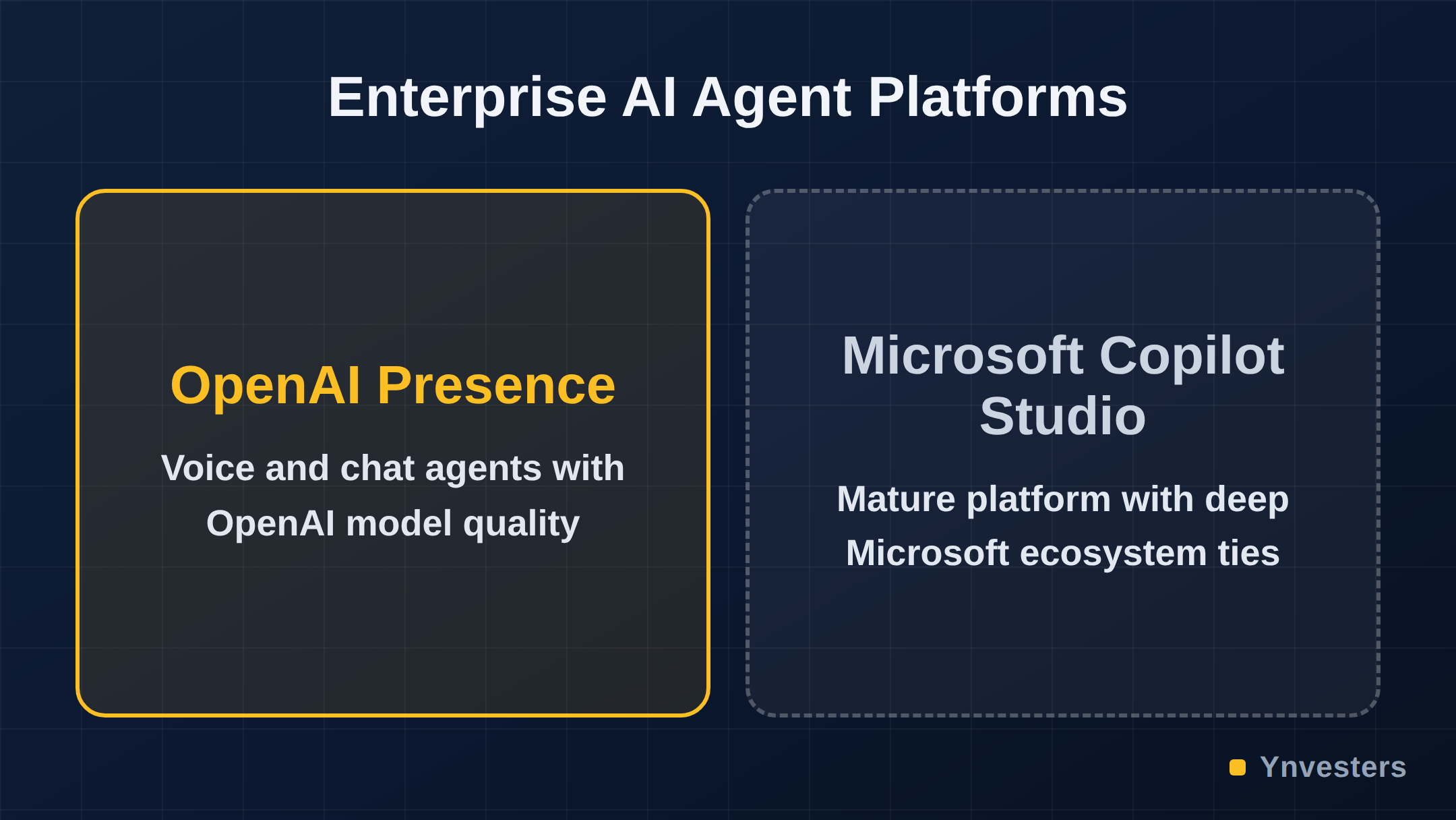
OpenAI’s potential advantage in this space is model quality — its underlying models are widely regarded as among the strongest available for natural language tasks, which matters enormously for voice and chat agents that need to handle nuanced conversations. However, model quality alone doesn’t win enterprise deals; integrations, compliance certifications, SLAs, and support all matter. OpenAI’s enterprise credibility has grown significantly since it launched ChatGPT Enterprise in 2023, which gives Presence a foundation to build on.
Q: Is the “proven” claim meaningful?
It’s worth pausing on OpenAI’s choice of the word “proven.” In enterprise software marketing, this word typically signals that a product has been deployed with real customers and has demonstrable results — as opposed to a beta or early-access product. If OpenAI has enterprise partners who have already run Presence in production, that’s a meaningful differentiator over newer entrants to the space.
That said, OpenAI has not published case studies, testimonials, or data to back up this claim publicly as of the announcement. We’d want to see those before treating “proven” as more than positioning language. Verify on their site as documentation emerges.
Q: Should I be paying attention to this, even if I’m not enterprise?
Yes — for two reasons.
First, OpenAI’s enterprise products have a pattern of influencing their consumer and API products. Features and models tested in enterprise settings often make their way into ChatGPT or the API, which affects every developer and creator building on OpenAI’s infrastructure.
Second, if you work within a larger organization — even as a contractor or agency partner — your clients may adopt Presence. Understanding what it does positions you to advise them, integrate with it, or build on top of it.
For background on how AI agents work in general, Wikipedia’s overview of intelligent agents is a useful primer if you’re newer to the category.
Q: What are the biggest unknowns right now?
To summarize the gaps that matter most for any serious evaluation:
- Pricing and packaging — No tiers, no minimums, no trial information announced
- Specific integrations — Which CRMs, telephony systems, or helpdesk tools does it connect to natively?
- Compliance and certifications — SOC 2, HIPAA, GDPR readiness? Not confirmed
- Customization depth — How much can organizations fine-tune agent behavior, tone, and escalation logic?
- Deployment timeline — General availability date not announced
Until these are answered, any definitive verdict on whether Presence beats the competition is premature.
Conclusion
OpenAI Presence is a real product announcement in a category that matters: enterprise AI agents for voice and chat. The positioning is clear, the use cases are logical, and OpenAI has the model quality to compete seriously. But the announcement is thin on the specifics that actually close deals — pricing, integrations, compliance details, and case studies are all missing as of now.
Our take: If you’re a solo creator or freelancer managing a lean AI subscription stack, OpenAI Presence is not for you at launch — and that’s fine. If you’re an ops leader, CX director, or agency advising enterprise clients, put this on your radar and request a demo once OpenAI’s sales team is accessible.
The one thing we’d caution against is letting the OpenAI brand alone be the reason you adopt it. The enterprise AI agent space is genuinely competitive, and platforms like Microsoft Copilot Studio and Google CCAI have years of enterprise integrations and compliance certifications that Presence will need to match. Watch the documentation closely over the next 30–60 days — that’s when the real picture will emerge.
Bookmark the official OpenAI Presence page and check back when pricing goes live.
Frequently Asked Questions
What is OpenAI Presence?
OpenAI Presence is an enterprise AI agent platform announced by OpenAI that lets organizations deploy voice and chat agents for customer-facing and internal workflows. It is described by OpenAI as a 'proven' platform, suggesting it may have been in limited use before the public announcement.
How much does OpenAI Presence cost?
Pricing for OpenAI Presence has not been publicly announced as of the time of writing. Check the official OpenAI site for current pricing details before making any budget decisions.
Is OpenAI Presence worth it for freelancers or solo creators?
Almost certainly not at launch. The platform is explicitly positioned for organizations and enterprise workflows, making it a poor fit for solo creators managing a $20–60/month AI budget.
How does OpenAI Presence compare to existing AI agent platforms?
OpenAI Presence competes in a crowded space alongside platforms like Salesforce Einstein, Microsoft Copilot Studio, and Google CCAI. OpenAI's edge is model quality, but feature and pricing parity is unverified until more details are released.