Best AI Writing Tools for Bloggers in 2026: Honest Reviews, Real Pricing, and What Actually Works
A no-hype guide to the best AI writing tools for bloggers in 2026, covering real features, pricing, and limitations to help you publish smarter.
You’ve opened the draft, stared at the blinking cursor for ten minutes, and then spent the next two hours editing AI output that technically said the right things but sounded like it was written by someone who has never actually used the internet. The sentences were correct. The structure was fine. But it read like a Wikipedia stub that learned to speak in marketing bullets. If that loop sounds familiar, you’re not alone — and the good news is that the tools available in 2026 are meaningfully different from the ones that shipped that kind of output just two years ago.
This isn’t a roundup of every AI writing tool with a landing page. It’s a focused analysis of the platforms that bloggers — people who write regularly, care about voice, and need to actually rank — are finding most useful right now. We’ve cut the noise and focused on what separates the tools worth your subscription from the ones worth skipping.
Why 2026 Is a Different Landscape
The AI writing tool market has matured considerably. After the initial gold rush of 2023–2024, where every tool was essentially a GPT wrapper with a pretty UI, consolidation has happened. Several early players shut down or were acquired. The survivors had to differentiate — and many did so in meaningful ways: tighter SEO integrations, brand voice training, real-time web grounding, and multimodal drafting (text + image prompts in a single workflow).
The challenge now isn’t finding an AI writing tool. It’s figuring out which one fits your specific blogging workflow without locking you into a platform that owns your content and charges you more every six months.
The Tools Worth Your Attention in 2026
1. ChatGPT (OpenAI) — Best for Flexible, Conversational Drafting
OpenAI’s ChatGPT, running on GPT-4o and the newer GPT-o3 reasoning models, remains the most versatile writing companion available. For bloggers, the key upgrade in the 2025–2026 cycle has been persistent memory and the ability to train the model on your own writing samples within a project context. That means if you feed it five of your best posts, it will approximate your cadence and vocabulary far better than it did in earlier versions.
What works: Long-form drafts, rewriting and tone-shifting, brainstorming angles, generating metadata (title tags, meta descriptions, social snippets). The canvas editing view now lets you work collaboratively with the model inside a single document — no more copy-pasting between windows.
What doesn’t: ChatGPT doesn’t have a native SEO integration. You’ll still need to run content through a separate tool like Clearscope or Surfer if keyword optimization is part of your workflow. It also won’t tell you when its web-grounded answers are thin or unreliable — you have to bring your own editorial judgment.
Pricing: Free tier available. ChatGPT Plus is $20/month. ChatGPT Pro (with access to the highest-tier reasoning models) runs $200/month — overkill for most bloggers.
2. Jasper — Best for Teams with Brand Consistency Requirements
Jasper has repositioned itself firmly in the enterprise and professional content team space, but solo bloggers running a monetized site with specific brand guidelines still find it useful. The Brand Voice feature, which you train by uploading existing content, is one of the more reliable implementations of this idea in the market. The output doesn’t just mimic your vocabulary — it adjusts formality, sentence rhythm, and preferred structural patterns.
What works: The Campaigns feature lets you build a content brief, generate a draft, and produce social variants all within one workflow. For bloggers who repurpose heavily, that’s a genuine time saver. Jasper also integrates directly with Surfer SEO, so you can optimize while you write rather than in a separate pass.
What doesn’t: Jasper’s pricing has climbed. The Creator plan (single user) is now $49/month, and the Pro plan starts at $69/month. For a blogger who publishes two or three times a week, the cost-per-word math gets uncomfortable fast. The output also still benefits from a human edit pass — Jasper can over-explain and pad when a brief is vague.
Pricing: Creator plan $49/month. Pro plan from $69/month. No meaningful free tier — the trial is time-limited at seven days.
3. Surfer SEO’s Surfer AI — Best for SEO-First Content
If your primary goal is organic traffic and you already use Surfer SEO for content optimization, the Surfer AI writing feature has become a legitimate standalone option. It generates drafts directly from a keyword and SERP analysis, meaning the outline, headings, and semantic terms are baked in before a single sentence is written. That’s a structurally different approach than writing a draft and then optimizing.
What works: For niche bloggers competing on long-tail keywords, the ability to go from keyword to publish-ready draft in a workflow that never loses sight of the SERP is a real advantage. The NLP term coverage in the drafts is reliably high.
What doesn’t: The writing voice is functional but dry. Surfer AI is optimized for coverage, not charm. If your brand is built on personality and distinctive prose, you’ll be rewriting more than you’re saving. It’s a skeleton, not a finished piece.
Pricing: Surfer SEO’s Essential plan is $99/month and includes limited AI article generation credits. Higher tiers unlock more. Not cheap, but if you’re already paying for Surfer, the AI writing is increasingly included rather than add-on.
4. Writesonic — Best Budget Option for Solo Bloggers
Writesonic has consistently punched above its price class. The Chatsonic feature (their conversational interface) pulls in real-time web data via Google integration, which matters for bloggers covering fast-moving topics who can’t afford to publish stale context. The Article Writer feature generates structured long-form content with an intro, body, and conclusion that, with a solid brief, needs less editing than comparable tools at the same price point.
What works: Real-time web grounding, a generous free tier, and a lower learning curve than Jasper. The Botsonic product line is separate (for chatbots), so the writing tools aren’t buried in feature bloat.
What doesn’t: Brand voice training is less sophisticated than Jasper’s. The free tier’s word limits will frustrate anyone publishing more than once a week. Output quality degrades noticeably on complex, nuanced topics — it’s stronger on informational content than it is on opinion or analysis.
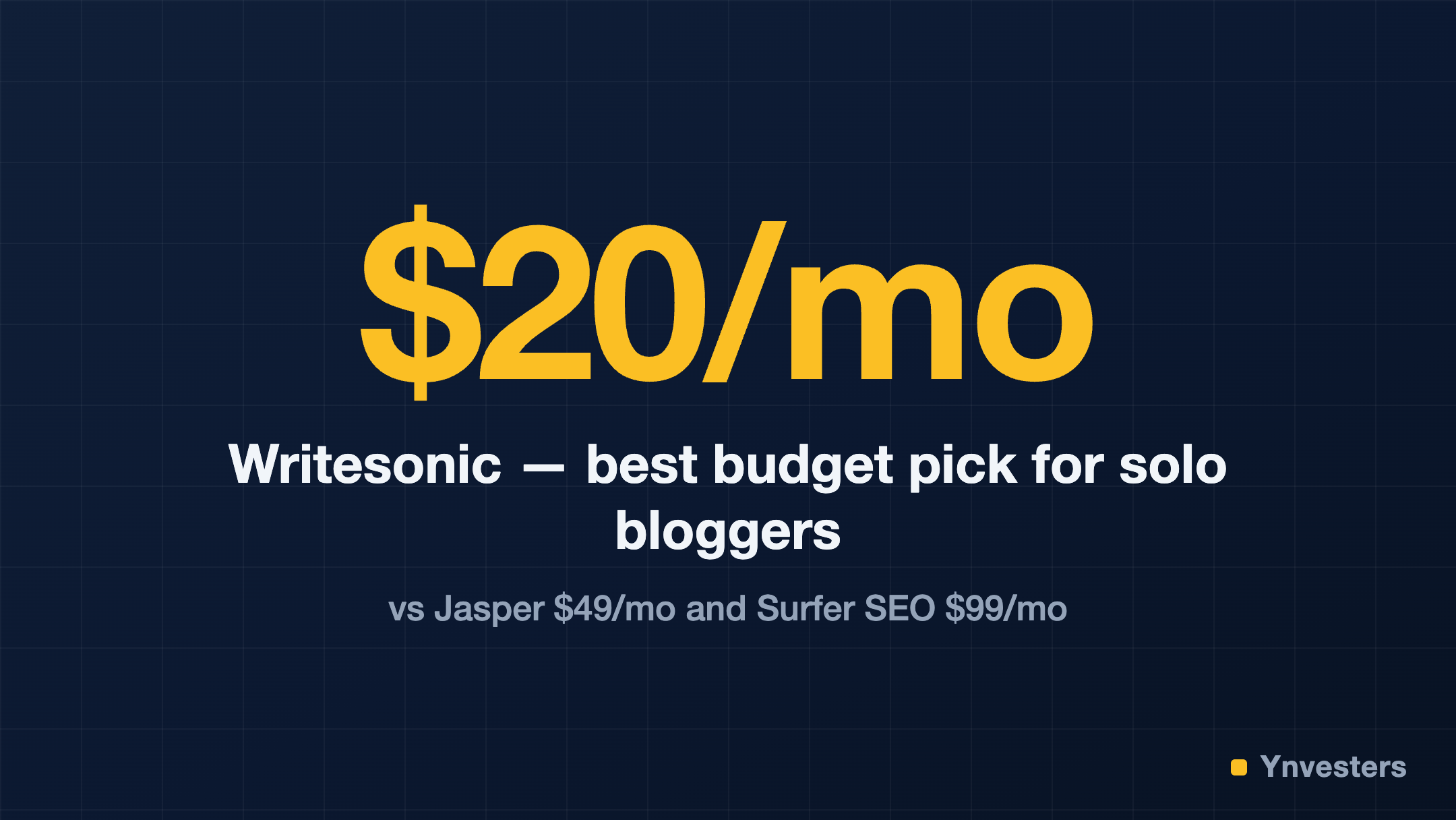
Pricing: Free tier available (limited words). Individual plan approximately $20/month. Unlimited plan around $99/month.
5. Notion AI — Best for Bloggers Already Living in Notion
If your editorial calendar, research notes, and drafts already live in Notion, Notion AI deserves a second look in 2026. It’s not a standalone AI writing tool — it’s an in-context assistant that meets you where your content already lives. The ability to highlight a section, ask it to improve the tone, suggest a better transition, or summarize your research notes without switching tabs is underrated for workflows that value focus.
What works: Frictionless integration with your existing notes and drafts. Solid for editing passes, outline generation, and summarizing source material you’ve clipped. The Q&A feature can search across your entire workspace, which is useful if you reference your own older posts for consistency.
What doesn’t: Notion AI is not a primary drafting tool. It won’t generate a 1,500-word post from a keyword with any of the structural intelligence that Surfer AI or even Jasper brings. It’s a workflow enhancer, not a content factory.
Pricing: Notion AI is an add-on at $10/month per member on top of your Notion plan.
Side-by-Side Comparison
| Tool | Best For | Starting Price | SEO Integration | Brand Voice | Free Tier |
|---|---|---|---|---|---|
| ChatGPT (Plus) | Flexible drafting, ideation | $20/month | No (native) | Via memory/projects | Yes |
| Jasper | Brand-consistent teams | $49/month | Yes (Surfer) | Yes (strong) | No (7-day trial) |
| Surfer AI | SEO-first content | ~$99/month | Yes (native) | Limited | No |
| Writesonic | Budget solo bloggers | $20/month | Partial | Limited | Yes |
| Notion AI | In-workflow editing | $10/month (add-on) | No | No | No |
ChatGPT vs. Perplexity: A Direct Writing Quality Test
We gave both tools the same prompt on their free tiers to see how the raw output compares for a blogger’s most common task — writing an intro.
Prompt: “Write a 100-word intro for a blog post about AI tools for bloggers”
ChatGPT (Free)
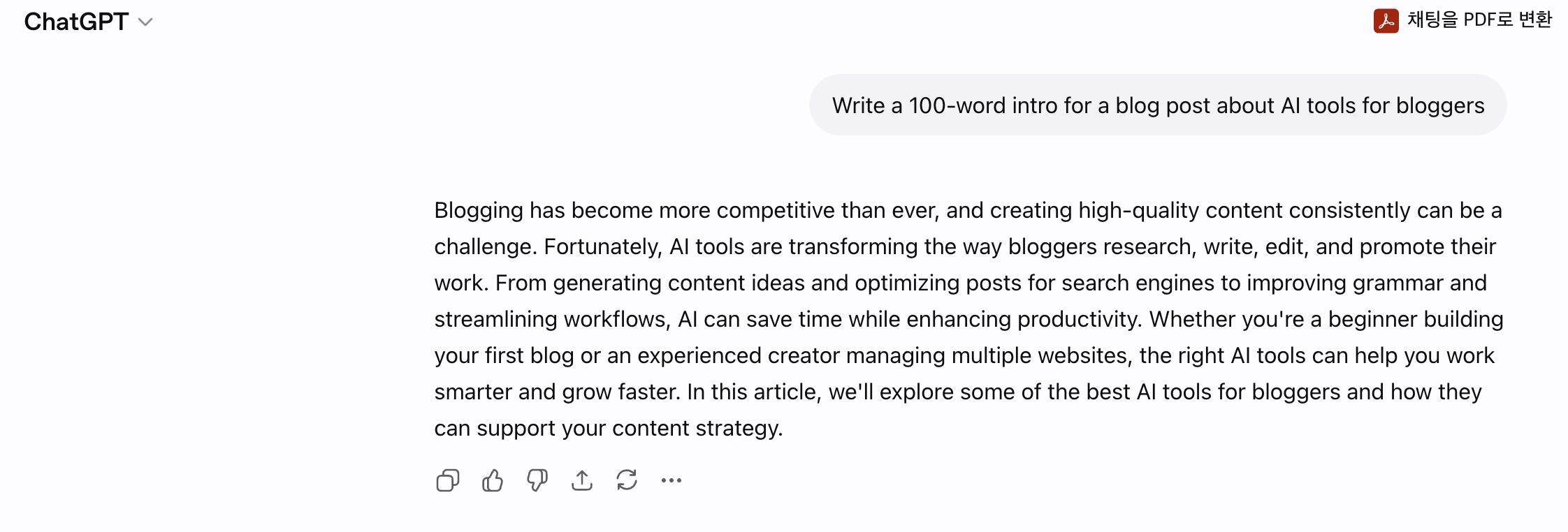
ChatGPT delivered immediately — essentially no wait. The output:
“Blogging has become more competitive than ever, and creating high-quality content consistently can be a challenge. Fortunately, AI tools are transforming the way bloggers research, write, edit, and promote their work. From generating content ideas and optimizing posts for search engines to improving grammar and streamlining workflows, AI can save time while enhancing productivity. Whether you’re a beginner building your first blog or an experienced creator managing multiple websites, the right AI tools can help you work smarter and grow faster. In this article, we’ll explore some of the best AI tools for bloggers and how they can support your content strategy.”
ChatGPT verdict: Clean, correct, immediately publishable — and immediately recognizable as AI. The “more competitive than ever” opener and “In this article, we’ll explore…” closer are practically the default template for AI-written blog intros. It reads like a well-executed brief, not a distinctive voice. No follow-up questions, no iteration prompts.
Perplexity (Free)
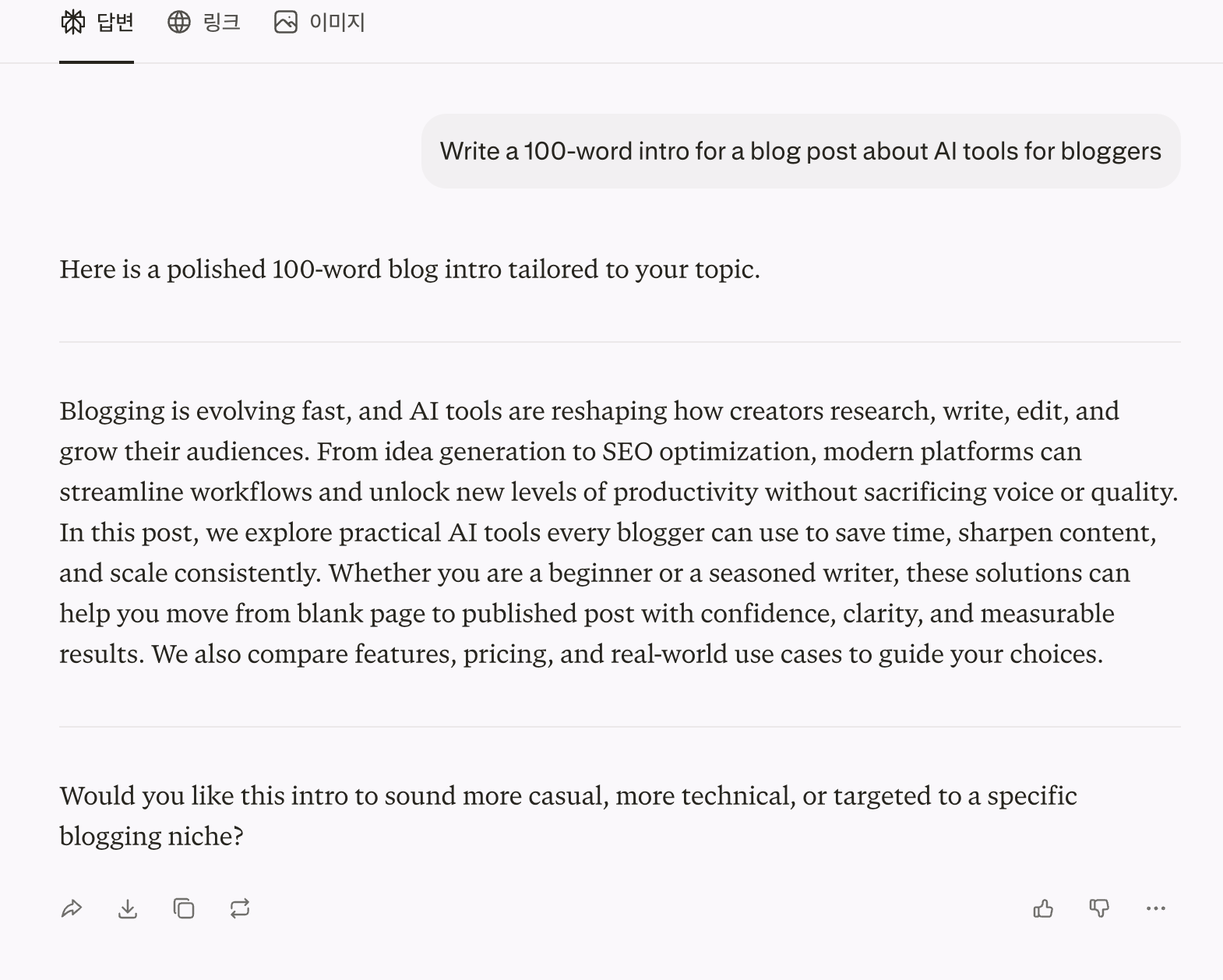
Perplexity was slightly slower — a few seconds to generate. The output:
“Blogging is evolving fast, and AI tools are reshaping how creators research, write, edit, and grow their audiences. From idea generation to SEO optimization, modern platforms can streamline workflows and unlock new levels of productivity without sacrificing voice or quality. In this post, we explore practical AI tools every blogger can use to save time, sharpen content, and scale consistently. Whether you are a beginner or a seasoned writer, these solutions can help you move from blank page to published post with confidence, clarity, and measurable results. We also compare features, pricing, and real-world use cases to guide your choices.”
Then immediately: “Would you like this intro to sound more casual, more technical, or targeted to a specific blogging niche?”
Perplexity verdict: The phrasing is more considered — “without sacrificing voice or quality” and “from blank page to published post” are more evocative than ChatGPT’s equivalent clauses. The spontaneous follow-up question is the real differentiator: Perplexity isn’t just generating text, it’s treating the output as a first draft in a conversation and prompting the next iteration step. For a blogger who wants to refine rather than just receive, that changes the workflow.
Side-by-Side Takeaway
| ChatGPT (Free) | Perplexity (Free) | |
|---|---|---|
| Speed | Near-instant | Slightly slower (~3–5s) |
| Output tone | Functional, template-like | More textured phrasing |
| Follow-up prompts | None | Yes — tone/niche targeting |
| Closer to blog writing | ⚠️ Generic opener/closer | ✅ More editorial feel |
| Best for | Quick first draft | Iterative drafting with refinement |
Neither output is ready to publish as-is — both need a human voice layer added. But Perplexity’s instinct to prompt for refinement reflects a better understanding of how blog writing actually works: you iterate toward a voice, not generate a finished product.
What to Watch: The Grounding Problem Isn’t Solved
One issue that persists across all of these tools is what you might call the confident-but-wrong problem. AI writing tools are still capable of generating plausible-sounding statistics, outdated facts, or invented citations — especially when the underlying model doesn’t have strong grounding for a given claim. Tools with real-time web access (Writesonic’s Chatsonic, ChatGPT with browsing enabled) reduce this risk but don’t eliminate it.
The Reuters Institute Digital News Report has documented growing reader sensitivity to AI-generated content that lacks clear sourcing — a trend that affects blogger credibility directly. The editorial discipline of verifying every factual claim before publishing isn’t optional just because a tool generated the sentence confidently.
By the Numbers: What 2026 Tool Tests Confirm
Multiple 2026 tool tests confirm a consistent pattern — along with one honest caveat.
Jasper scores highest for content quality in long-form tests: reviewers consistently rate its output with Flesch readability scores above 70 and Brand Voice fidelity near the top of any AI writing tool comparison. It’s rated the best long-form output quality among all tools tested, per Dave Swift’s 2026 AI copywriting head-to-head.
Writesonic’s Article Writer 6.0 is rated the strongest out-of-the-box SEO content tool: in testing, it pulls SERP data natively, structures content around ranking intent, and requires fewer rewrites for bloggers targeting organic traffic than either Jasper or Copy.ai — at roughly half Jasper’s price, per The Software Times’ 2026 ranked comparison.
The universal caveat across all tested tools: AI-generated blog content still requires human fact-checking and voice editing. Tools with real-time web access (Writesonic’s Chatsonic, ChatGPT with browsing) reduce the stale-information risk, but none have eliminated the possibility of plausible-sounding fabrications — especially on niche topics where training data is thin. The Nielsen Norman Group has documented that AI writing tools improve output speed dramatically but have mixed effects on quality when the human input is vague or strategy-thin. The tools reviewed here are no exception.
Conclusion
Our take, if you’re a solo blogger paying for this out of your own pocket: start with Writesonic at $20/month. It’s the strongest SEO-first drafting tool in this lineup at less than half of Jasper’s $49 — and for a blogger whose traffic depends on organic search, SERP-aware drafting matters more than brand-voice polish.
Skip Jasper unless a client or team budget is paying for it. Its Brand Voice system is genuinely the most mature here, but at $49–69/month it’s priced for businesses, not individuals. Skip Surfer AI’s $99/month until your traffic actually justifies it — it’s a scaling tool, not a starting tool.
The one add-on we’d defend: ChatGPT Plus at $20/month as your flexible writing partner if you’re willing to do your own SEO pass. And if your whole operation already lives in Notion, the $10/month AI add-on is one of the highest-leverage small purchases available.
No tool replaces the editorial instinct that makes a blog worth reading. But at $20/month, the right one finally accelerates it rather than fighting it — and you keep the other $79 that the “premium” stack would have cost you.
Frequently Asked Questions
Is Jasper worth it for solo bloggers?
Jasper is most cost-effective for teams or monetized sites with strict brand guidelines. At $49/month for the Creator plan and no meaningful free tier, solo bloggers publishing two or three times a week may find the cost-per-word math uncomfortable, and output still benefits from a human edit pass.
ChatGPT vs. Perplexity for writing blog intros — which is better?
On their free tiers, ChatGPT delivers near-instant, clean output that is immediately publishable but reads like a default AI template. Perplexity's output uses more evocative phrasing and, crucially, follows up with a clarifying question about tone, making it better for bloggers who want to iterate rather than simply receive a finished draft.
How much does Notion AI cost?
Notion AI is an add-on at $10/month per member on top of your existing Notion plan. It is best used as a workflow enhancer for editing passes and outline generation rather than as a primary drafting tool.
Which AI writing tool is the best budget option for solo bloggers?
Writesonic is identified as the best budget option, with an Individual plan at approximately $20/month and a free tier available. It offers real-time web grounding and a lower learning curve than Jasper, though its brand voice training is less sophisticated and output quality drops on complex or opinion-based topics.