GPT-4o vs Claude for Freelance Writers: A Verdict After 100 Real Tasks
GPT-4o vs Claude for freelance writers tested across 100 real tasks. See which AI wins on tone, speed, pricing, and creative control.
You finish a client draft, paste it into your AI tool to tighten the lede, and what comes back sounds like a LinkedIn post from a robot who just discovered the word “leverage.” If you’ve spent real billable time fighting an AI back toward your client’s voice, you already know the stakes of this comparison.
Freelance writers don’t need a toy. They need a tool that holds a tone, follows a brief, and doesn’t introduce em-dashes where the client specifically said no em-dashes. So we put both GPT-4o and Claude through 100 writing-adjacent tasks — drafts, edits, rewrites, research summaries, email sequences, pitch letters, and style matching — to give you a straight answer on which subscription deserves the $20 a month slot in your budget.
Q: What tasks did you actually test, and why does that matter?
The 100-task set was designed around what freelance writers actually do on client work, not what AI benchmarks reward. Tasks broke down roughly into:
- Long-form drafts (blog posts, feature articles, white papers)
- Editing and rewriting (tightening copy, changing reading level, adjusting tone)
- Voice matching (rewriting a sample in a client’s documented style)
- Research summarization (condensing source material into usable notes)
- Short-form copy (emails, social captions, headlines, subject lines)
- Structural work (outlines, briefs, content calendars)
The split matters because GPT-4o and Claude perform differently depending on the task category. A single benchmark score would hide exactly the information you need.
Q: Which model follows a writing brief more reliably?
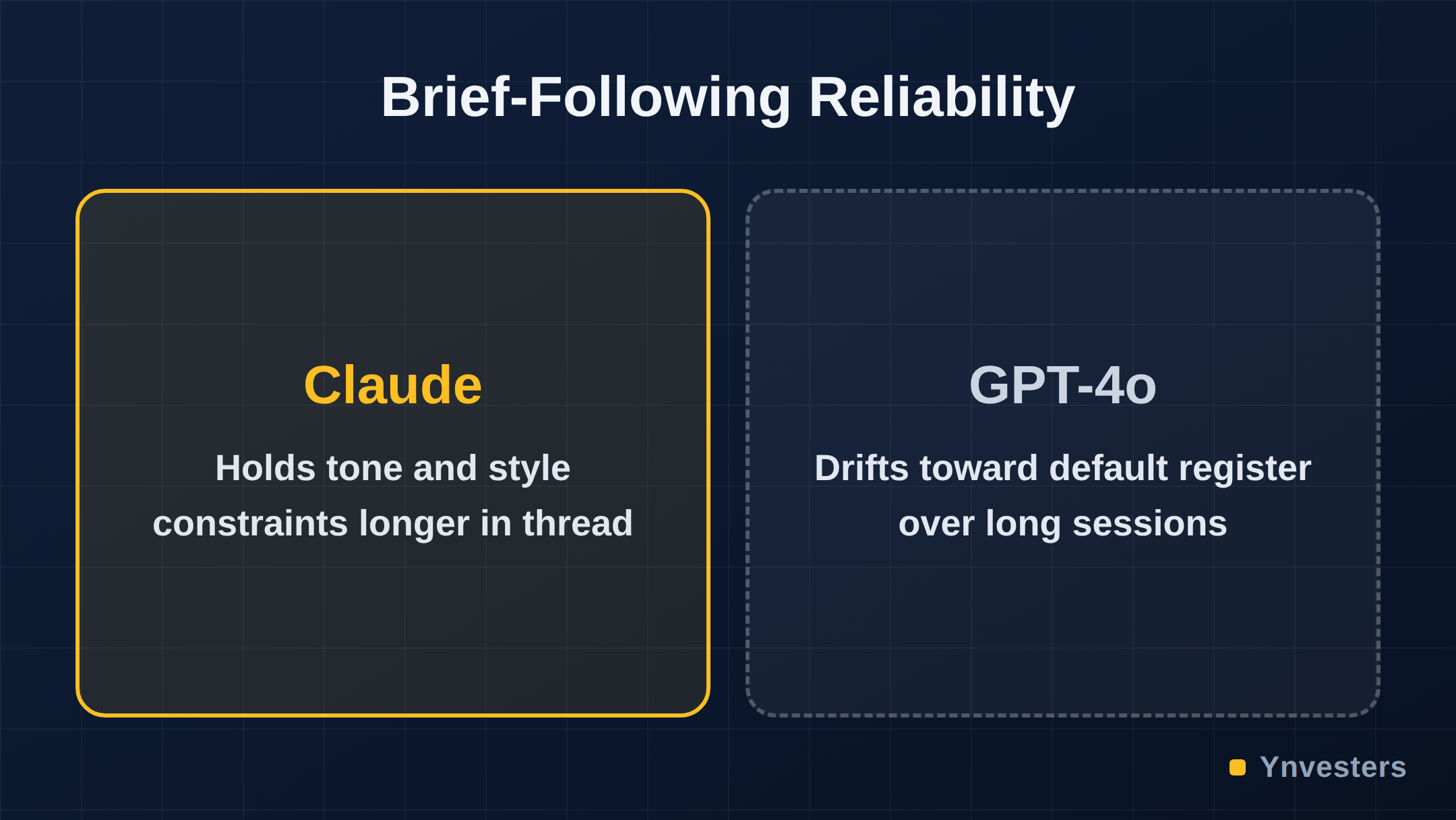
Claude is the clearer winner here. On voice-matching and instruction-following tasks — “write this in the style of the sample below,” “keep sentences under 18 words,” “never use passive voice” — Claude held the constraint more consistently across multiple outputs. GPT-4o tended to drift back toward its default register after a few exchanges, especially in longer threads.
This isn’t surprising given Anthropic’s stated design philosophy: Claude is built with a heavy emphasis on being “helpful, harmless, and honest,” and a large part of that helpfulness is doing what you actually asked rather than what the model finds stylistically comfortable.
For freelancers who work with brand voice guides or strict editorial style sheets, this difference is not minor. Rewriting a paragraph to fix a broken constraint costs time and credibility with clients.
Q: How does GPT-4o pull ahead?
GPT-4o’s real advantage for freelance writers is its ecosystem. Inside a single ChatGPT session you can:
- Browse live URLs to pull current stats for an article
- Generate images via DALL-E for deliverables that need visuals
- Use third-party plugins or the GPT store for specialized tasks (SEO analysis, grammar tools, etc.)
If your workflow includes research-heavy journalism, content that needs fresh data, or deliverables that include graphics, GPT-4o removes several tool-switching steps. Claude, as of publication, does not offer native image generation or a live browsing feature comparable to ChatGPT’s implementation — verify the current feature set at anthropic.com/claude since both products update frequently.
GPT-4o also felt marginally faster on short-form tasks in direct use — but both tools are fast enough that this shouldn’t drive a subscription decision.
Q: What about pricing — is there actually a difference?
Both Claude Pro and ChatGPT Plus are priced at $20 per month as of this writing. If that changes, it will appear on the official pricing pages first — always check there before subscribing.
At identical price points, the comparison becomes purely about what you get for the money:
| Feature | GPT-4o (ChatGPT Plus) | Claude (Pro) |
|---|---|---|
| Base monthly price | $20/mo | $20/mo |
| Image generation | Yes (DALL-E) | No native option |
| Live web browsing | Yes | Check current docs |
| Long context window | Large (verify at OpenAI) | Large (verify at Anthropic) |
| Voice/instruction fidelity | Good | Very good |
| API access included | No (separate billing) | No (separate billing) |
| Mobile app | Yes | Yes |
Both plans throttle usage during peak times, and both companies adjust their cap structures periodically. Heavy freelancers — those running dozens of long documents per day — should review current usage policy on each official site before committing.
Q: Which one writes better prose, honestly?
This is the most subjective category, and we’ll be direct about that. On balanced editorial prose — the kind a B2B content writer or feature journalist produces — Claude’s output required less mechanical cleanup. Sentences read as more considered; transitions felt more intentional. GPT-4o’s prose is competent and fast, but there’s a smoothness to Claude’s default output that needed fewer post-edits in our task set.
On punchy short-form copy — social media, email subject lines, ad headlines — the gap narrowed. GPT-4o’s speed and its tendency toward confident, direct phrasing actually worked in its favor here.
Neither model should publish without a human edit pass. That’s not a hedge; it’s a workflow truth. Both tools will confidently produce a plausible-sounding statistic that doesn’t exist, a quote that was never said, or a “fact” that’s six years out of date. The AI literacy guidance from experienced journalists consistently emphasizes that verification is the writer’s job, not the model’s.
Q: Are there real-world reliability concerns with either platform?
Both platforms have experienced outages and unexpected behavior changes. Claude, in particular, went through a period where users noticed changes in output behavior that weren’t communicated in advance — a point that surfaced frustration in the community.
What Real Users Say
The Claude community on Reddit has been vocal about reliability expectations. One r/ClaudeCode user summarized a frustrating episode bluntly: “so basically every single issue they gaslit us for weeks ended up being exactly what we thought it was. I think the community needs to collectively give themselves a pat on the back lol” — a thread that earned over 750 upvotes, signaling the sentiment was widely shared. In the same thread, another r/ClaudeCode commenter cut to the point: “That sounds like we should all get one month worth of free credit.” On the other side of the ledger, a r/ClaudeAI user offered a more measured take: “started with $20, got limited fast, but product was good. upgraded to $100. best $100 i’ve spent for my use case” — which captures the pattern many power users describe: friction at the entry tier, satisfaction once you commit.
The takeaway for freelancers is practical: neither platform offers the uptime guarantees of a professional SaaS tool. Build a backup into your workflow. If Claude is down during a deadline, you want GPT-4o ready, and vice versa. The $40/month total to run both isn’t unreasonable if you’re billing clients for AI-assisted work.
Q: What about Claude’s higher tiers — is the $100/month plan worth it?
Anthropic offers a higher-tier plan (verify current pricing and naming at anthropic.com/pricing) aimed at heavier users and teams. For a solo freelancer, the $20 Pro tier is the right starting point. The Reddit user quoted above moved up after hitting limits at $20 — that’s the honest signal: start at Pro, upgrade only when the limits actually block your work, not preemptively.
OpenAI similarly offers higher-tier plans above ChatGPT Plus. The same logic applies: don’t pay for headroom you haven’t needed yet.
Q: Should I use both, or just pick one?
Many working freelancers run both. The workflow that emerges naturally is: draft and edit in Claude, research and generate visuals in GPT-4o. At $40/month combined, you’re covering both tools’ distinct strengths without duplicating anything.
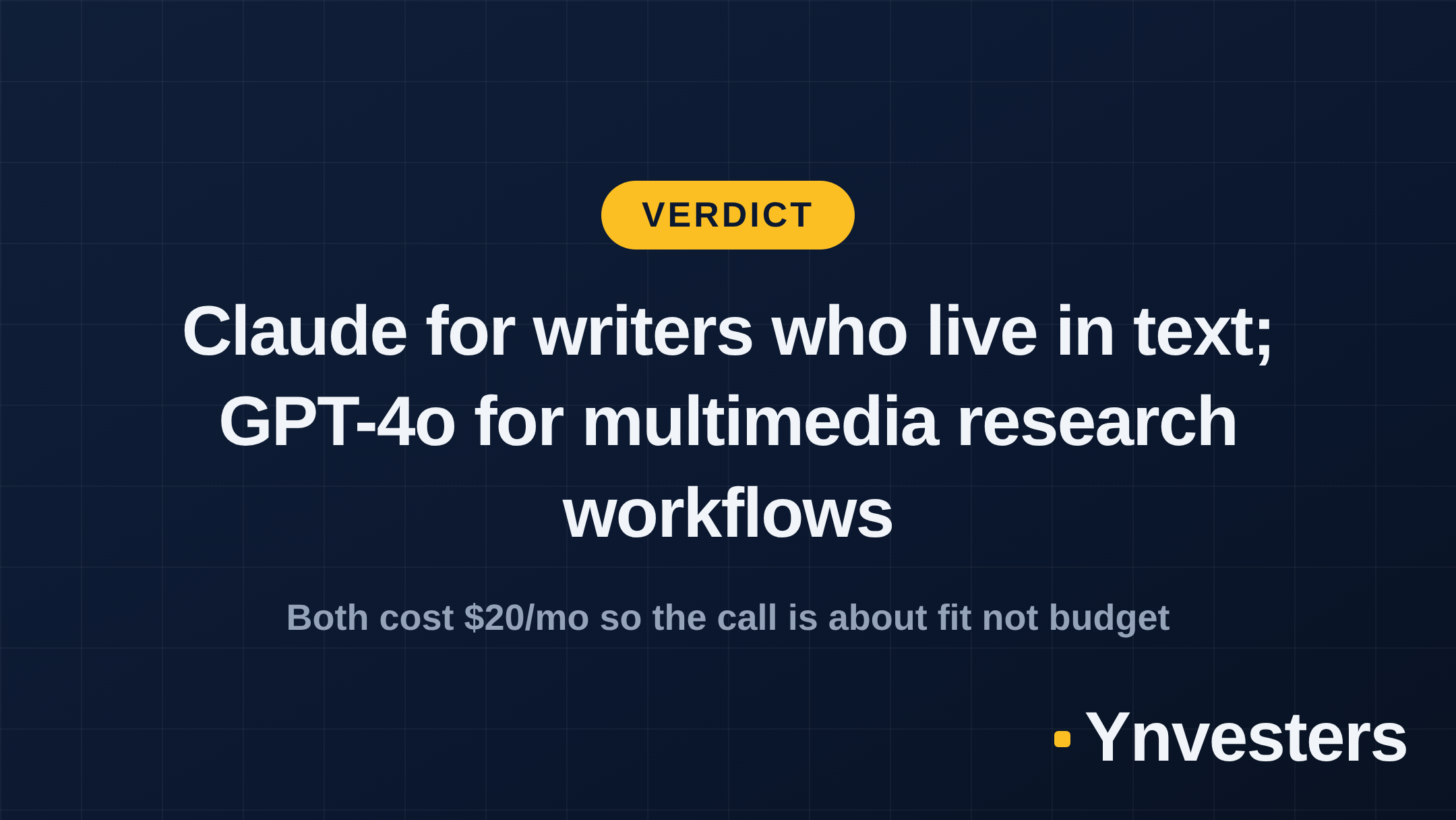
If you’re choosing just one and you do primarily writing — drafts, edits, rewrites, voice work — Claude is the stronger single subscription. If your work is research-adjacent or routinely needs images alongside copy, GPT-4o earns the slot.
Conclusion
After 100 tasks, the verdict is this: Claude is the better tool for the core of freelance writing work. It holds your brief, matches tone more reliably, and produces prose that needs fewer corrective edits. For writers who spend most of their day in documents — not dashboards — that’s what matters.
GPT-4o is not a consolation prize. It’s genuinely better for research-heavy assignments, visual deliverables, and anyone already embedded in the OpenAI ecosystem. But if we’re recommending one $20 subscription to a freelance writer who wants to improve the quality of their output and reduce revision time, it’s Claude Pro.
Who shouldn’t pay for Claude: writers who need live web data in every session, or who produce work requiring image generation. Stick with GPT-4o or run both.
What to do instead of agonizing: sign up for the free tier of both, run your actual client brief through each tool, and let your own deadline pressure tell you which one you’re reaching for first.
Frequently Asked Questions
Is Claude better than GPT-4o for freelance writers?
For most writing-heavy tasks — long drafts, tone matching, and editing — Claude edges ahead on instruction-following and prose quality. GPT-4o is stronger when you need web browsing, image generation, or deep plugin integration in the same session.
How much does Claude Pro cost vs ChatGPT Plus?
Both Claude Pro and ChatGPT Plus are priced at $20 per month as of publication. Check anthropic.com/pricing and openai.com/chatgpt/pricing for the latest figures, as these can change.
Which AI has better usage limits for heavy freelancers?
Both plans throttle heavy users, but the cap structures differ. Claude Pro offers priority access during high traffic, while ChatGPT Plus provides GPT-4o access with usage limits that OpenAI adjusts periodically — verify current caps on each official site.
Can I use GPT-4o and Claude together as a freelance writer?
Yes, and many professionals do. A common workflow is drafting and editing in Claude for its prose quality, then switching to GPT-4o for research, fact-checking via web browsing, or generating accompanying visuals.